
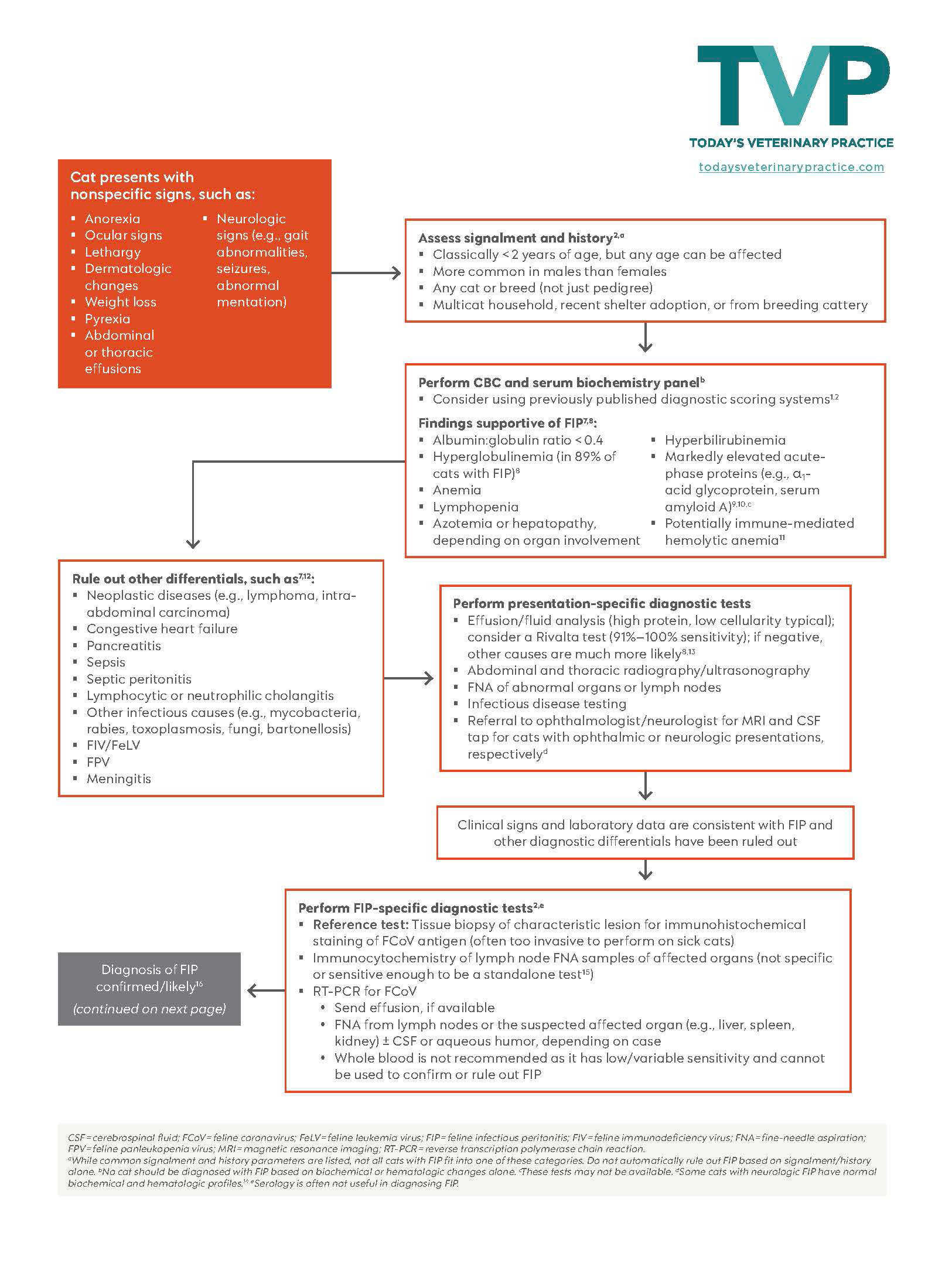
Diagnosis of feline infectious peritonitis (FIP) can present clinical challenges, but obtaining a timely and precise diagnosis is imperative to treatment success. The widespread availability of antiviral medications for FIP makes successful patient outcomes common when cats are diagnosed accurately and treatment is started early.
Before prioritizing diagnostic tests for FIP, it is critical to adequately rule out diagnostic differentials that may mimic FIP. It is inappropriate to use antivirals for suspected FIP without having adequately assessed for the presence and risk of other differentials. Once such differentials have been ruled out, treatment trials with antiviral medications may be considered. Of note, treatment trials may be needed in cases with high suspicion for, but without confirmed diagnosis of, FIP (e.g., by reverse transcription PCR testing). In such cases, a recheck of the cat’s response to the antiviral therapy is recommended within a few days; if there is no improvement, other differentials need to be considered and tests performed to investigate them.
Using expert-developed scoring systems to gauge the likelihood of FIP can be helpful. The Brisbane score can increase confidence in suspicion of FIP by providing quantitative diagnostic criteria for assessing an individual patient.1 The European Advisory Board on Cat Diseases has also developed excellent diagnostic scoring systems that can help when FIP is suspected.2
After a definitive diagnosis has been obtained, or if there is a strong suspicion for FIP in a patient with appropriate clinicopathologic findings, treatment should be started as quickly as possible. The 2 antiviral classes currently used to treat this disease are nucleoside analogues (remdesivir and its active metabolite GS-441524 and molnupiravir and its active metabolite EIDD-1931) and protease inhibitors (nirmatrelvir–ritonavir and GC376 [not commercially available]). Nucleoside analogues are the most well-studied and have proven safety and efficacy for FIP.3-5 Protease inhibitors may have some efficacy as add-on treatments or as treatment for refractory cases,6 but more research regarding their use is needed.
This algorithm focuses on FIP diagnosis and when and how to treat this disease. However, because the presentation of this disease is variable, readers are encouraged to explore the extensive reviews available online,2,7 which provide more detail.
- Try to keep monitoring using laboratory testing to a minimum to reduce excess costs to the caregiver and stress to the cat; if the cat is clinically improving at home based on owner phone check-ins, consider performing follow-up tests 3–4 weeks after starting treatment.
- Focus on previously abnormal values for that individual patient (e.g., hematocrit, packed cell volume, bilirubin).
- Albumin and globulin normalization may take several weeks.
- Evaluation of basic parameters (e.g., CBC, serum biochemistry panel, acute-phase proteins like α1-acid glycoprotein where available) at 6 and 12 weeks is recommended; adjust as needed to 3 and 6 weeks if using a 42-day course.
References
- Clark TM, Coggins SJ, Korman R, King J, Malik R. Treatment of feline infectious peritonitis in cats with molnupiravir: clinical observations and outcomes for 54 cases. Aust Vet J. 2025;103(6):339-353. doi:10.1111/avj.13433
- Tasker S, Addie DD, Egberink H, et al. Feline infectious peritonitis: European Advisory Board on Cat Diseases guidelines. Viruses. 2023;15(9):1847. doi:10.3390/v15091847
- Pedersen NC, Perron M, Bannasch M, et al. Efficacy and safety of the nucleoside analog GS-441524 for treatment of cats with naturally occurring feline infectious peritonitis. J Feline Med Surg. 2019;21(4):271-281. doi:10.1177/1098612X19825701
- Coggins SJ, Norris JM, Malik R, et al. Outcomes of treatment of cats with feline infectious peritonitis using parenterally administered remdesivir, with or without transition to orally administered GS-441524. J Vet Intern Med. 2023;37(5):1772-1783. doi:10.1111/jvim.16803
- Taylor SS, Coggins S, Barker EN, et al. Retrospective study and outcome of 307 cats with feline infectious peritonitis treated with legally sourced veterinary compounded preparations of remdesivir and GS-441524 (2020-2022). J Feline Med Surg. 2023;25(9):1098612X231194460. doi:10.1177/1098612X231194460
- Lv J, Bai Y, Wang Y, Yang L, Jin Y, Dong J. Effect of GS-441524 in combination with the 3C-like protease inhibitor GC376 on the treatment of naturally transmitted feline infectious peritonitis. Front Vet Sci. 2022;28(9):1002488. doi:10.3389/fvets.2022.1002488
- Thayer V, Gogolski S, Felten S, Hartmann K, Kennedy M, Olah GA. 2022 AAFP/EveryCat feline infectious peritonitis diagnosis guidelines. J Feline Med Surg. 2022;24(9):905-933. doi:10.1177/1098612X221118761
- Felten S, Hartmann K. Diagnosis of feline infectious peritonitis: a review of the current literature. Viruses. 2019;11(11):1068. doi:10.3390/v11111068
- Helfer-Hungerbuehler AK, Spiri AM, Meili T, et al. Alpha-1-acid glycoprotein quantification via spatial proximity analyte reagent capture luminescence assay: application as diagnostic and prognostic marker in serum and effusions of cats with feline infectious peritonitis undergoing GS-441524 therapy. Viruses. 2024;16(5):791. doi:10.3390/v16050791
- Romanelli P, Bertazzolo W, Prisciandaro A, Leone A, Bonfanti U, Paltrinieri S. Measurement of feline alpha-1 acid glycoprotein in serum and effusion using an ELISA method: analytical validation and diagnostic role for feline infectious peritonitis. Pathogens. 2024;13(4):289. doi:10.3390/pathogens13040289
- Černá P, Knies M, Assink M, et al. Immune-mediated hemolytic anemia in cats with feline infectious peritonitis. Pathogens. 2025;14(7):660. doi:10.3390/pathogens14070660
- Tasker S. Diagnosis of feline infectious peritonitis: update on evidence supporting available tests. J Feline Med Surg. 2018;20(3):228-243. doi:10.1177/1098612X18758592
- Fischer Y, Sauter-Louis C, Hartmann K. Diagnostic accuracy of the Rivalta test for feline infectious peritonitis. Vet Clin Pathol. 2012;41(4):558-567. doi:10.1111/j.1939-165X.2012.00464.x
- Crawford AH, Stoll AL, Sanchez-Masian D, et al. Clinicopathologic features and magnetic resonance imaging findings in 24 cats with histopathologically confirmed neurologic feline infectious peritonitis. J Vet Intern Med. 2017;31(5):1477-1486. doi:10.1111/jvim.14791
- Felten S, Hartmann K, Doerfelt S, Sangl L, Hirschberger J, Matiasek K. Immunocytochemistry of mesenteric lymph node fine-needle aspirates in the diagnosis of feline infectious peritonitis. J Vet Diagn Invest. 2019;31(2):210-216. doi:10.1177/1040638718825280
- Reagan K. New insights on feline infectious disease — Treatment of FIP in the remdesivir era: how, when and why to stop. ACVIM course. May 15, 2025. Accessed July 24, 2026. https://www.acvim.org/events-education/course-catalog/new-insights-feline-infectious-disease
- Taylor S, Tasker S, Barker E, et al. An update on the treatment of feline infectious peritonitis. International Cat Care. July 2025. Accessed January 15, 2026. https://icatcare.org/resources/icatcare_fip_update_july25.pdf
- Zuzzi-Krebitz AM, Buchta K, Bergmann M, et al. Short treatment of 42 days with Oral GS-441524 results in equal efficacy as the recommended 84-day treatment in cats suffering from feline infectious peritonitis with effusion—a prospective randomized controlled study. Viruses. 2024;16(7):1144. doi:10.3390/v16071144
- Buchta K, Zuzzi-Krebitz AM, Bergmann M, et al. Unexpected clinical and laboratory observations during and after 42-day versus 84-day treatment with oral GS-441524 in cats with feline infectious peritonitis with effusion. Viruses. 2025;17(9):1181. doi:10.3390/v17091181
- Roy M, Jacque N, Novicoff W, Li E, Negash R, Evans SJM. Unlicensed molnupiravir is an effective rescue treatment following failure of unlicensed GS-441524-like therapy for cats with suspected feline infectious peritonitis. Pathogens. 2022;11(10):1209. doi:10.3390/pathogens11101209
- Buchta K, Friederich J, Zuzzi-Krebitz AM, et al. Myocarditis in cats with feline infectious peritonitis can be cured with GS-441524 and symptomatic cardiovascular treatment. Animals (Basel). 2025;15(11):1660. doi:10.3390/ani15111660