
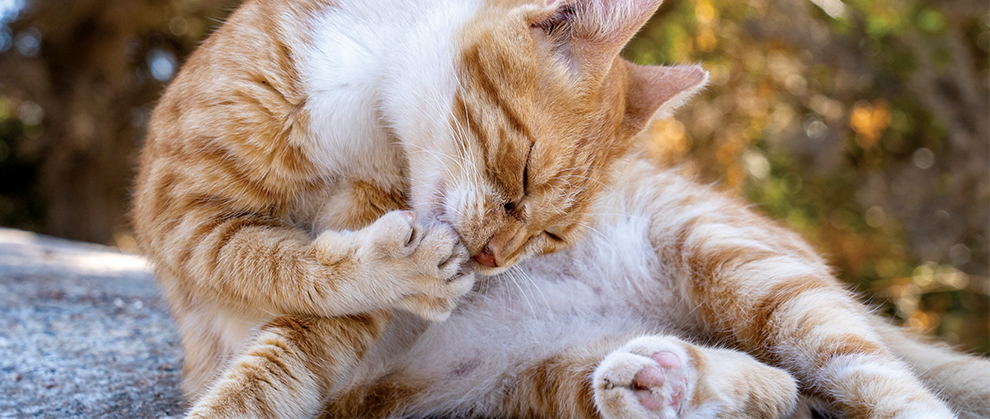
Feline hyperesthesia syndrome (FHS) is characterized by episodic rippling or twitching of the skin, agitation, and self-directed grooming or biting. FHS should be a diagnosis of exclusion with possible dermatologic, pain-related, neurologic, and/or neurobehavioral contributors. Many behavioral signs commonly associated with FHS have also been noted in healthy cats; therefore, diagnosis should not be based on any single finding. A practical approach focuses on targeted diagnostics and therapeutic trials. Most cats experience significant improvement after multimodal diagnostics and therapy, although some require ongoing management.
Take-Home Points
- Inflammatory skin disorders; neuropathic, spinal, musculoskeletal, gastrointestinal, tail, and anal sac pain; and seizures should be ruled out before signs are assumed to be primarily behavioral.
- First-line therapeutic trials to consider include NSAIDs, prednisolone, oclacitinib and/or an elimination diet, or levetiracetam.
- Environmental and behavioral management should be implemented for all patients.
- In terms of prognosis, the realistic goal is usually better control of episode frequency, severity, and self-trauma rather than complete cure.
Feline hyperesthesia syndrome (FHS) is a challenging presentation in practice because the clinical signs can be dramatic but the differential list broad and the underlying cause often unclear. This article answers the most common questions regarding FHS.
Q: What is the presentation for cats with FHS?
FHS is a clinical syndrome characterized by episodic rippling or twitching of the skin over the dorsum (particularly the thoracolumbar area) and epaxial musculature, often accompanied by agitation; sudden grooming or biting of the back, tail, pelvic limbs, or flanks; tail chasing or swishing; vocalization; running or hiding; or sudden startle behavior (VIDEO 1).1,2 Some cats also bite or scratch at their front legs or paws, and during severe episodes, some may defecate while running.3 Episodes are often brief, and many cats appear normal between events, although some exhibit persistent overgrooming, alopecia, or self-trauma.
In some cats, episodes may be triggered by touch. Documented recurring triggers, published in a case report for 1 cat, included cigarette smoke and scented candles.4 However, many episodes begin without any obvious external trigger.
Q: Is FHS a behavioral disorder?
Not necessarily. FHS is best understood as a syndrome and is a diagnosis of exclusion with possible dermatologic, pain-related, neurologic, neurobehavioral, and cutaneous sensory contributors, alone or in combination. Prematurely diagnosing a behavioral condition risks missing a treatable cause.
Inflammatory skin disorders (e.g., ectoparasitism, allergic dermatitis, adverse food reactions, dermatophytosis) can produce licking, biting, twitching, agitation, or self-trauma that resembles FHS. A published case report described a cat for which FHS-like clinical signs resolved after eating an elimination diet and recurred with dietary rechallenge, supporting the possibility that food-responsive disease can be exhibited as FHS.5
Cats cannot describe dysesthesia, paresthesia, tactile allodynia, or other sensory discomfort; therefore, twitching, sudden grooming, agitation, or self-directed behavior may be the only visible expression. Causes to consider include neuropathic, spinal, musculoskeletal, gastrointestinal, tail, and anal sac pain.
When episodes are highly stereotyped, abrupt, nonresponsive to interruption, or accompanied by other neurologic features (e.g., a pre- or postictal period), focal seizures should be considered.2 A case report describing 2 cats for which electroencephalography showed epileptiform discharges found that for both patients, episodes reduced significantly within weeks of starting anticonvulsant therapy.6
Behavioral contributors may still be relevant, especially when episodes seem to be linked to arousal, anxiety, frustration, conflict, or environmental stressors; however, physical causes deserve consideration first, and an unrevealing workup does not resolve the case as behavioral by default.
Q: What is the approach to a diagnostic workup?
The workup should begin with a careful history and full physical, dermatologic, orthopedic, and neurologic examinations. Useful questions include patient age at onset, episode frequency and duration, whether episodes are stereotyped, whether the patient appears normal between events, and whether identifiable triggers are present. Client video of an episode is also helpful.
Isolated findings noted at the time of physical examination should not be overinterpreted. A study found that reaction to lumbar palpation during a veterinary examination was not significantly associated with FHS signs at home, making it an unreliable standalone diagnostic criterion.7
In many cats, the first step with the highest yield is an attempt to rule out physical contributors, which, depending on the presentation, may include thorough ectoparasite control, skin cytology, fungal testing, trichography, and anal sac evaluation; flea control should be instituted even for indoor cats.2 A broader workup can include CBC, blood chemistry, thyroid testing, urinalysis, testing for fecal antigen and feline leukemia/feline immunodeficiency viruses, and radiography.
Advanced imaging, cerebrospinal fluid analysis, or electrodiagnostic evaluation may be appropriate when the cat exhibits neurologic deficits, severe or progressive signs, marked self-trauma, poor response to initial therapy, or strong clinical suspicion for focal seizures or spinal pain.6,8
Q: What therapeutic trials should general practitioners reasonably consider?
Therapeutic trials should address the leading differentials; however, a positive treatment response, although helping the cat clinically, may not confirm the underlying cause.
When orthopedic or musculoskeletal pain is a concern, a trial of NSAID(s) is a reasonable starting point although unlikely to be sufficient when neuropathic pain is a major contributor.9
When pruritus or an inflammatory skin condition is more likely, a prednisolone trial is more appropriate.2 For some cats that exhibit generalized licking or scratching, gastrointestinal signs, or other reasons to suspect an allergic or food-responsive component, oclacitinib and/or an elimination diet can also be considered.5,10-12
If focal seizure activity is suspected, levetiracetam is a reasonable option for a shorter-term trial without a definitive epilepsy diagnosis.13
Q: What medications may be used longer term?
Longer-term medication choices depend on the cat’s clinical phenotype, and combination therapy may be necessary (TABLE 1). Response to psychotropic medications does not lead to a behavioral diagnosis.
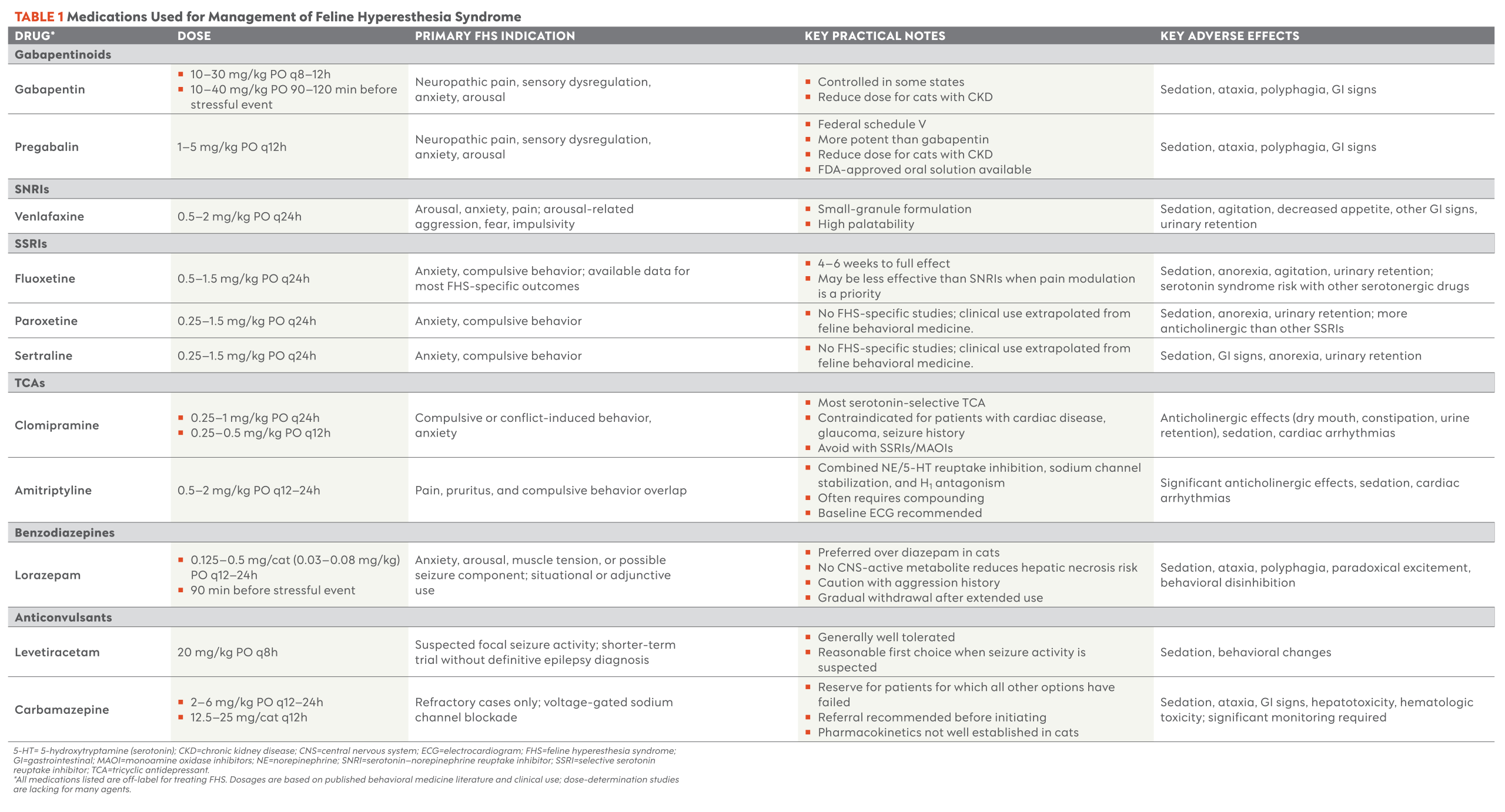
Gabapentin and pregabalin are valid first-line options when neuropathic pain, sensory dysregulation, or mixed pain-arousal features are suspected.1,2,14 They may provide analgesic and anxiolytic effects by binding to the α2δ subunit of voltage-gated calcium channels and reducing excitatory neurotransmitter release.4,15
Venlafaxine, a serotonin–norepinephrine reuptake inhibitor (SNRI), is appealing when arousal, anxiety, and pain overlap. Noradrenergic effects become more prominent at higher doses,16,17 which is relevant because norepinephrine plays a central role in descending inhibitory pain pathways, allowing venlafaxine to address both arousal and pain modulation.9 Two studies support venlafaxine use for fear, aggression, impulsivity, and arousal-related disorders,16,17 although its use for FHS has not been specifically evaluated.
A selective serotonin reuptake inhibitor (SSRI) or tricyclic antidepressant may be appropriate for cats with an anxiety-related or compulsive phenotype, although SSRIs are generally considered less effective than SNRIs for neuropathic pain, making venlafaxine more mechanistically attractive when pain modulation is a goal.9 The most FHS-specific outcome data are for fluoxetine. In a retrospective series of 28 cats, fluoxetine-only treatment was associated with a median recovery time of 8 days and a 94% rate of episode-free periods of at least 9 months.1 Clomipramine has documented utility for treating feline compulsive disorders.2 For cats in which pain, pruritus, and compulsive behavior overlap, amitriptyline is worth considering due to its combined serotonin–norepinephrine reuptake inhibition, dorsal horn voltage-gated ion channel modulation, and H1-receptor antagonism; a common limitation is palatability.1,2,9
Lorazepam may be a useful situational or adjunctive medication for FHS.2 It acts as a positive allosteric modulator at γ-aminobutyric acid type A receptors, producing anxiolytic, muscle-relaxant, and anticonvulsant effects.18 Its primary metabolite has no significant central nervous system activity, lowering the risk for idiopathic hepatic necrosis and physical dependence compared with diazepam.18 In practice, many cats respond with increased relaxation, amicability, and confidence; however, caution is warranted for use in cats with a history of aggression, and gradual withdrawal is recommended after extended use.
In refractory cases, topiramate or carbamazepine may be considered, although both have monitoring requirements and limited evidence for use in cats with FHS.2,9
Q: What nonpharmacologic management is helpful?
Environmental and behavioral management should be implemented for all patients with suspected FHS. Because chronic stress and anxiety can amplify pain perception and sensory reactivity, environmental management is not merely supportive but may also directly reduce episode severity and lower the long-term medication burden.9 Environmental and behavioral management includes identifying and minimizing triggers; reducing conflict and frustration; providing species-appropriate enrichment (e.g., vertical space, hiding areas, foraging opportunities, regular structured play); ensuring adequate and separated resources in multicat households; and strictly avoiding punishment, as punishment can worsen fear, anxiety, and repetitive behavior.3
Patients for which episodes initially seem unpredictable may be linked to specific triggers (e.g., scent), making antecedent identification and avoidance a valuable part of management.
Q: What is the prognosis?
Prognosis depends on whether underlying contributors can be identified and managed. Clients should be counseled that the realistic goal is usually better control of episode frequency, severity, and self-trauma rather than complete cure.
The data support a prognosis that is hopeful, even in difficult cases. In a retrospective series of 28 cats in which 50% continued pharmacotherapy, 82% experienced an episode-free period of at least 9 months, 93% no longer had clinical signs after 1 year, and relapse was reported for only 1 cat.1 In a separate series of 7 cats with severe FHS and tail mutilation, 6 improved clinically and 5 achieved remission.2
Q: When should referral be considered?
Referral is appropriate when the cat exhibits significant self-trauma, neurologic abnormalities, progressive signs, frequent or severe episodes, or an incomplete response to a reasonable first-line plan. Depending on the patient, referral to a dermatology, neurology, pain management, or veterinary behavior specialist may be helpful. Some cats ultimately require a multidisciplinary approach.
Summary
For the general practitioner, the key to managing FHS is resisting the urge to label the problem as behavioral too early. A cat with rippling skin, twitching, agitation, or sudden self-directed behavior should be assessed broadly for dermatologic disease, pain, neurologic disease, and neurobehavioral contributors. A practical approach combines a targeted workup with therapeutic trials directed at the leading differentials, followed by longer-term multimodal treatment tailored to the individual cat.
References
- Pauciulo C, Uccheddu S, Corda A, et al. Long-term clinical response to medical treatment, behavioral therapy, or their combination in cats with hyperesthesia syndrome. J Vet Intern Med. 2025;39(4):e70174. doi:10.1111/jvim.70174
- Amengual Batle P, Rusbridge C, Nuttall T, Heath S, Marioni-Henry K. Feline hyperaesthesia syndrome with self-trauma to the tail: retrospective study of seven cases and proposal for an integrated multidisciplinary diagnostic approach. J Feline Med Surg. 2019;21(2):178-185. doi:10.1177/1098612X18764246
- Tynes VV. Abnormal repetitive behaviors: stereotypies and compulsive disorders. In: Landsberg GM, Ackerman L, Radosta L, eds. Behavior Problems of the Dog and Cat. 4th ed. Elsevier; 2023:323-343.
- McPeake KJ, Peregrin M, Hepple A, Gunn-Moore D. Scent as a trigger of feline hyperaesthesia syndrome. Vet Rec Case Rep. 2025;13(1):e1059. https://doi.org/10.1002/vrc2.1059
- Ruiz-Suarez N, Bhatti SFM, Hermans M, Baptista da Silva C, Hesta M. Food hypersensitivity and feline hyperaesthesia syndrome (FHS): a case report. Vet Med (Praha). 2021;66(8):363-367. doi:10.17221/118/2020-VETMED
- Gómez Álvarez CM, Soler Arias EA. Feline hyperesthesia syndrome: epilepsy as possible aetiology in two cats. Vet Rec Case Rep. 2021;9(3):e132. https://doi.org/10.1002/vrc2.132
- Avril M, Lamoureux A, Valentin S, Jeandel A. Prevalence of behavioural signs commonly associated with feline hyperaesthesia syndrome among healthy cats. J Small Anim Pract. 2025;66(10):700-707. doi:10.1111/jsap.13878
- Sivolapenko D, Lowrie M. Epileptic seizures in cats: practical approaches to diagnosis. J Feline Med Surg. 2026;28(2):1098612X251407905. doi:10.1177/1098612X251407905
- Rusbridge C. Neuropathic pain in cats: mechanisms and multimodal management. J Feline Med Surg. 2024;26(5):1098612X241246518. doi:10.1177/1098612X241246518
- Noli C, Matricoti I, Schievano C. A double-blinded, randomized, methylprednisolone-controlled study on the efficacy of oclacitinib in the management of pruritus in cats with nonflea nonfood-induced hypersensitivity dermatitis. Vet Dermatol. 2019;30(2):110-e30. doi:10.1111/vde.12720
- Carrasco I, Ferrer L, Puigdemont A. Efficacy of oclacitinib for the control of feline atopic skin syndrome: correlating plasma concentrations with clinical response. J Feline Med Surg. 2021;24(8):787-793. doi:10.1177/1098612X211048458
- Lopes NL, Campos DR, Machado MA, et al. A blinded, randomized, placebo-controlled trial of the safety of oclacitinib in cats. BMC Vet Res. 2019;15(1):137. doi:10.1186/s12917-019-1893-x
- Mastrocco A, Prittie J, West C, Clark M. A review of the pharmacology and clinical applications of levetiracetam in dogs and cats. J Vet Emerg Crit Care (San Antonio). 2024;34(1):9-22. doi:10.1111/vec.13355
- Miranda-Cortés AE, Prado-Ochoa MG, Díaz-Torres R, et al. Comparison of the anxiolytic and analgesic effects of gabapentin and pregabalin in cats: a systematic review. Animals (Basel). 2025;15(16):2346. doi:10.3390/ani15162346
Crowell-Davis SL, Irimajiri M, Dantas LMS. Anticonvulsants and mood stabilizers. In: Crowell-Davis SL, Murray TF, Dantas LMS, eds. Veterinary Psychopharmacology. 2nd ed. Wiley-Blackwell; 2019:147-156. - Metz D, Medam T, Masson S. Double-blind, placebo-controlled trial of venlafaxine to treat behavioural disorders in cats: a pilot study. J Feline Med Surg. 2021;24(6):539-549. doi:10.1177/1098612X211036792
- Masson S, Metz D, Bleuer-Elsner S, Schwobthaler F. Retrospective study on the use of venlafaxine in 176 cats diagnosed with behavioral disorders. J Vet Behav. 2025;77:1-10. https://doi.org/10.1016/j.jveb.2024.11.004
- Dantas LMS, Crowell-Davis SL. Benzodiazepines. In: Crowell-Davis SL, Murray TF, Dantas LMS, eds. Veterinary Psychopharmacology. 2nd ed. Wiley-Blackwell; 2019:67-102.