
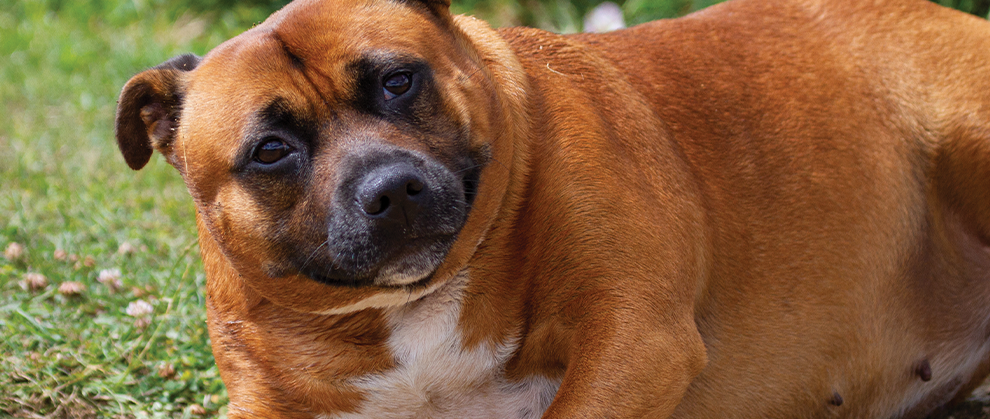
Canine obesity is one of the most common nutritional conditions encountered in small animal practice, and its prevalence continues to rise, affecting over half of adult dogs across the United States. However, successful weight loss management, or even discussing obesity with clients, remains challenging. Fortunately, the veterinary team now has a better understanding of what motivates clients to address obesity: the desire to help their dogs live longer and healthier lives. Emphasizing the meaningful benefits through positive framing and celebrating even small wins may help veterinary teams engage clients and support successful weight management for patients.
Take-Home Points
- Even partial weight loss (e.g., 5% to 10% of body weight) brings meaningful benefits and builds momentum for long-term success.
- Earlier intervention leads to better outcomes.
- Nutrition strategy is more than simply cutting calories.
- Factor in treats to support weight loss.
- Keys to success are personalizing the nutrition plan and following up with the client.
A growing body of evidence shows that weight loss and maintaining a lean body condition of dogs can improve their health and increase their lifespan. Even modest weight loss (e.g., 5% to 10% reduction in initial body weight), before an ideal body condition score (BCS) is achieved, provides clinically meaningful benefits (BOX 1). Achieving a dog’s ideal weight is considered a major milestone that requires a long-term commitment from clients, often taking several months to more than a year, depending on the dog’s initial weight.25,26 Getting a dog to its ideal weight and body condition can be challenging; achieving a healthy weight for their dog has been reported by only 28% of owners,27 and even within a referral specialty clinic, only 61% completed the weight-loss program.25
Overall benefits of achieving and maintaining a lean body condition
Lifespan
- Maintaining a lean ideal body condition score (4 of 9) increases median lifespan by 1.8 years1
Osteoarthritis
- Delays both radiographic osteoarthritis onset by 6 years2 and the need for long‑term treatment by 3 years in Labradors1
- Improves lameness with weight loss3-5
Quality of life
- Improves quality of life after weight loss, including increased vitality and reduced pain and emotional disturbance6
Sarcopenia
- Delays age-related decline in lean body mass1
Blood lipids
- Improves blood lipid profile after weight loss7-9
Inflammation and oxidative stress
- Decreases chronic low-grade inflammation after weight loss10-13
- Weight loss reduces oxidative stress14 and improves antioxidant capacity7
Respiratory function
- Improves respiratory function after weight loss15
- Improves oxygenation during deep sedation after weight loss16
Cardiac health (partial remodeling)
- Decreases systolic left ventricular wall thickness after weight loss17,18
- Decreases interventricular septal thickness to left ventricular internal diameter in diastole after weight loss19
Kidney health
- Decreases obesity-associated renal biomarkers, suggesting that subclinical renal alterations improve after weight loss20,21
Specific benefits of partial weight loss
Osteoarthritis
- Decreases lameness in dogs with osteoarthritis from approximately 6% body weight loss onward3
Activity
- Increases activity during weight loss; improvement begins early after approximately 3.2% body weight loss, continued at subsequent visits.22
- Increases distance walked during the 6-minute walk test during weight loss; improvement before achieving ideal body weight is significant.23
Quality of life
- Improves quality of life during weight loss, with progressive improvement from approximately 5.7% body weight loss on.22
Blood lipid
- Approximately 6% body weight loss is associated with significant improvement in blood cholesterol7
Cardiac health
- Decreases left ventricular diameter after approximately 4.7% body weight loss, suggesting partial reversal of cardiac hypertrophy.24
Research on the psychology of human workplace motivation shows that what drives day-to-day performance is the sense of making progress in meaningful work.28 Even small steps forward can dramatically enhance inner work life and improve performance.28 Small wins can create momentum through self-reinforcing benefits.28
That concept applies well to veterinary weight-management programs. Early progress, such as emphasizing the benefits of partial weight loss, can provide meaningful and positive reinforcement for client adherence and commitment to the plan. The veterinary team plays a key role by acting as catalysts of progress, helping clients recognize early improvements, set clear goals (e.g., weekly weight-loss targets and food amount), and receive ongoing support with empathy. Small wins can increase success by transforming a daunting long-term process into a series of achievable milestones.
This article focuses on the positive effects of weight loss and how small wins can support better outcomes; it provides practical approaches to help veterinarians guide clients through the process.
A Practical Approach to Canine Weight Loss
After an overweight or obese patient is identified, key determinants of weight-loss success are timing of the intervention and choice of treatment strategy.
Timing
Initiating weight loss when a dog is only mildly overweight is associated with greater success than waiting until the dog is heavier. As the degree of fat mass increases, outcomes of a weight-loss program tend to worsen; loss of lean muscle mass is greater, rates of weight loss are slower, program duration is longer, and likelihood of reaching target weight is lower.25,26
As dogs age, degenerative conditions and comorbidities (e.g., chronic kidney disease requiring dietary protein restriction) can make weight loss more challenging and limit dietary options because standard hypocaloric, high-protein weight-loss diets may no longer be appropriate. However, partial weight loss can still deliver meaningful benefits, even for dogs with comorbidities such as osteoarthritis.3
Treatment Strategies
Weight-Loss Diet
The key nutritional concepts for weight loss are as follows:
- Reduce calories to create a negative energy balance.
- Increase protein to help preserve lean muscle mass and support satiety.
- Include higher fiber, especially insoluble fiber, to enhance fullness.29
A factor that is often overlooked for weight-loss diets is nutrient density. Even with fewer calories, dogs still need all essential nutrients. For this reason, weight-loss diets must be carefully formulated and fortified to ensure that nutritional requirements are met despite calorie restriction. The choice between over-the-counter (OTC) diets and therapeutic weight-loss diets really matters (CASE EXAMPLE). OTC diets, including those that are labeled as “light,” “lite,” or “low-calorie” formulas (which are AAFCO-regulated terms indicating controlled calorie content), as well as those that make weight-related claims such as “healthy weight,” “weight control,” or “weight management” (which are not regulated and rely on manufacturers to substantiate those claims) may not always provide the same level of nutrient fortification as therapeutic weight-loss diets.
Calorie needs during weight loss can vary widely depending on the individual dog, including its activity level and metabolism. Unless otherwise specified, all energy calculations in this article are based on estimated ideal body weight. Overweight dogs generally require substantially lower calorie intake for their maintenance energy requirement, often around 0.9 to 1 of the life stage factor,30 and in some cases as low as 0.6.22,25,31 In contrast, most commercial adult dog foods are formulated under the assumption that calorie intake should be consistent with typical adult maintenance needs, which are often substantially higher than what many overweight dogs require.
Restricting OTC diets to achieve weight loss increases the risk for nutrient deficiencies.32-34 Of note, only 22% of dog owners attempting weight loss for their dog report having used a therapeutic weight-loss diet.27 Therefore, the veterinary team should guide clients to the appropriate diet when significant caloric restriction is required (≤ 1 life stage factor).30
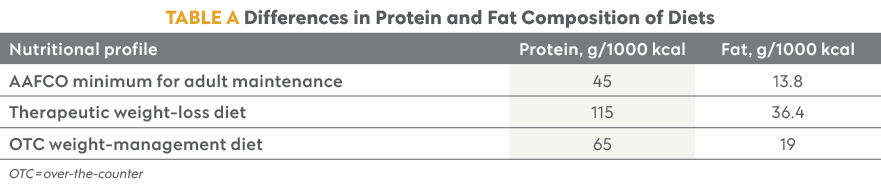
But what happens to daily protein and fat intake when calories are restricted?
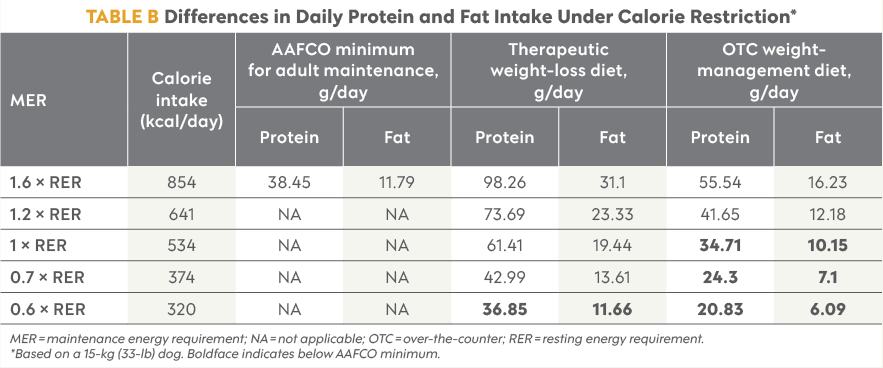
At the same level of calorie restriction, dogs will receive markedly different amounts of protein and fat from the diets, particularly under more severe restriction required for weight loss, and there is a risk for nutritional deficiency (Table B). Dogs require more than 30 essential nutrients, not just protein and fat.
Feeding Amounts
Weight loss is not just about cutting back a fixed percentage of a dog’s current diet and hoping for the best until next year’s visit. Instead, a stepwise, personalized approach to determining the right feeding amount for each dog sets the client and patient up for long-term success.
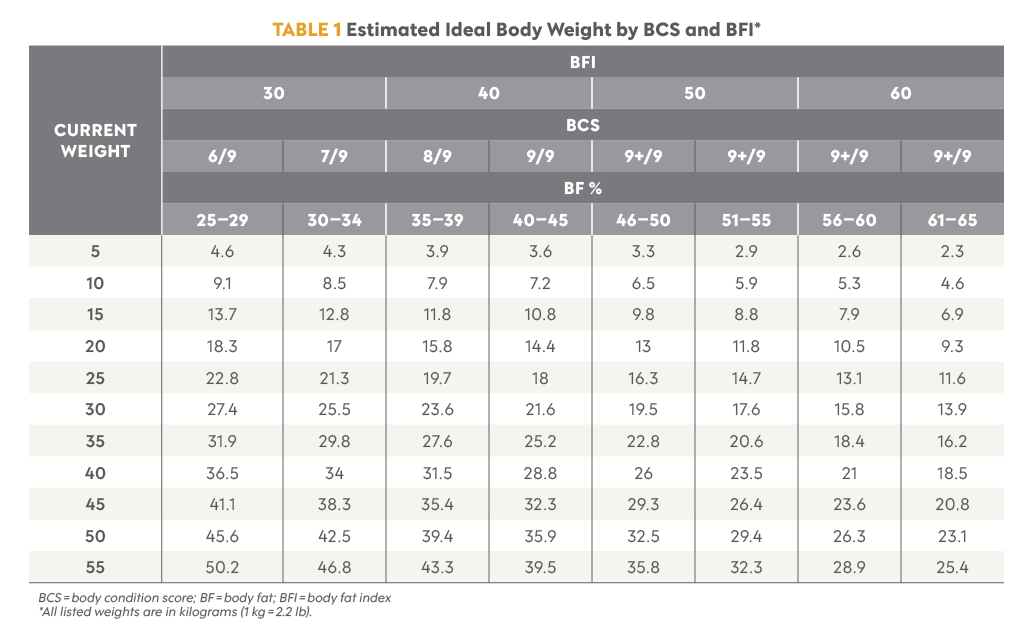
- Estimate the patient’s ideal body weight. Ideal body weight is best estimated by using DEXA (dual-energy X-ray absorptiometry). However, in clinical practice, the most practical and accessible tools that correlate with body fat percentage are BCS35 and body fat index36 (TABLE 1).
- Calculate resting energy requirement (RER). Use the estimated ideal body weight to calculate RER (RER = BWkg0.75 × 70).30
- Assess current total daily calorie intake. Include all food sources: the main diet, toppers, treats, human food, and supplements.
- Estimate maintenance energy requirement (MER). Compare current intake with RER to determine an appropriate starting point. For many dogs, a weight-loss energy allocation of 1 × RER is a reasonable starting estimate, especially when current intake exceeds RER. However, individual requirements vary. Mildly overweight dogs consuming excess calories may be successful with higher factors (e.g., 1.2 to 1.4), whereas some obese dogs, particularly those with a history of regaining weight or current intake near RER, may require a lower factor (e.g., ≤ 0.9).
- Incorporate treats into MER. Treats are an important part of many families’ routines. They support the human–animal bond, serve as training rewards, and can be a real game changer for a sustainable weight-loss program. However, to avoid unbalancing essential nutrient intake from a complete and balanced diet (≥ 90% MER), they should be limited to ≤ 10% of MER. There are many low-calorie treat options that dogs can enjoy while staying on track for weight loss. For families that require more frequent treats, consider using a portion of the dog’s daily complete and balanced diet as treats (e.g., using kibble as training treats, offering canned food in enrichment toys or frozen as treats).
- Monitor and adjust intake. The key to successful weight loss is regular follow-up with clients, providing support throughout the program. The goal for the dog should be a 1% to 2% body weight loss per week; if the weekly weight-loss rate falls outside this range, calorie intake should be adjusted by 10%.37 Remember, the ideal body weight based on BCS and body fat index is only the starting point.
- Maintain weight. After the dog’s ideal or target body weight has been achieved or a clinically meaningful outcome has been reached, carefully adjust calorie intake (e.g., increase by 5% to 10% at a time) to maintain body weight with a focus on recognizing and reinforcing the success already made, no matter how small. The final MER and corresponding life stage factor can help guide long-term diet selection.
Summary
Ultimately, canine obesity is a disease the veterinary team has the opportunity to treat. By working together, the veterinary team and clients can transform a challenging journey into a series of small, meaningful wins. Small wins matter not only because they build momentum toward long-term success but also because they give dogs healthier years to enjoy with the families who love them.
References
- Kealy RD, Lawler DF, Ballam JM, et al. Effects of diet restriction on life span and age-related changes in dogs. JAVMA. 2002;220(9):1315-1320. doi:10.2460/javma.2002.220.1315
- Smith GK, Paster ER, Powers MY, et al. Lifelong diet restriction and radiographic evidence of osteoarthritis of the hip joint in dogs. JAVMA. 2006;229(5):690-693. doi:10.2460/javma.229.5.690
- Marshall WG, Hazewinkel HAW, Mullen D, De Meyer G, Baert K, Carmichael S. The effect of weight loss on lameness in obese dogs with osteoarthritis. Vet Res Commun. 2010;34(3):241-253. doi:10.1007/s11259-010-9348-7
- Impellizeri JA, Tetrick MA, Muir P. Effect of weight reduction on clinical signs of lameness in dogs with hip osteoarthritis. JAVMA. 2000;216(7):1089-1091. doi:10.2460/javma.2000.216.1089
- Marshall WG, Bockstahler BA, Hulse DA, Carmichael S. A review of osteoarthritis and obesity: current understanding of the relationship and benefit of obesity treatment and prevention in the dog. Vet Comp Orthop Traumatol. 2009;22(5):339-345. doi:10.3415/VCOT-08-08-0069
- German AJ, Holden SL, Wiseman-Orr ML, et al. Quality of life is reduced in obese dogs but improves after successful weight loss. Vet J. 2012;192(3):428-434. doi:10.1016/j.tvjl.2011.09.015
- Stefanutti D, Serva L, Berlanda M, et al. Effect of a weight loss diet with or without Spirulina supplementation on serum lipids and antioxidant capacity of overweight dogs. Sci Rep. 2024;14(1):29293. doi:10.1038/s41598-024-80843-y
- Oba PM, Kelly J, Kostiuk D, Swanson KS. Effects of weight loss and feeding specially formulated diets on the body composition, blood metabolite profiles, voluntary physical activity, and fecal metabolites and microbiota of obese dogs. J Anim Sci. 2023;101:skad073. doi:10.1093/jas/skad073
- Diez M, Michaux C, Jeusette I, Baldwin P, Istasse L, Biourge V. Evolution of blood parameters during weight loss in experimental obese Beagle dogs. J Anim Physiol Anim Nutr (Berl). 2004;88(3-4):166-171. doi:10.1111/j.1439-0396.2003.00474.x
- Wakshlag JJ, Struble AM, Levine CB, Bushey JJ, Laflamme DP, Long GM. The effects of weight loss on adipokines and markers of inflammation in dogs. Br J Nutr. 2011;106(S1):S11-S14. doi:10.1017/S0007114511000560
- German AJ, Hervera M, Hunter L, et al. Improvement in insulin resistance and reduction in plasma inflammatory adipokines after weight loss in obese dogs. Domest Anim Endocrinol. 2009;37(4):214-226. doi:10.1016/j.domaniend.2009.07.001
- Jeremias JT, Vendramini THA, Rodrigues RBA, et al. Markers of inflammation and insulin resistance in dogs before and after weight loss versus lean healthy dogs. Pesqui Vet Bras. 2020;40(4):300-305. https://doi.org/10.1590/1678-5150-PVB-6245
- Phungviwatnikul T, Lee AH, Belchik SE, Suchodolski JS, Swanson KS. Weight loss and high-protein, high-fiber diet consumption impact blood metabolite profiles, body composition, voluntary physical activity, fecal microbiota, and fecal metabolites of adult dogs. J Anim Sci. 2022;100(2):skab379. doi:10.1093/jas/skab379
- Cavalcante CZ, Michelotto PV, Capriglione LGA, Roncoski AT, Nishiyama A. Weight loss modifies lipid peroxidation and symmetric dimethylarginine levels in obese dogs. Can J Vet Res. 2023;87(1):29-34.
- Pereira-Neto GB, Brunetto MA, Oba PM, et al. Weight loss improves arterial blood gases and respiratory parameters in obese dogs. J Anim Physiol Anim Nutr (Berl). 2018;102(6):1743-1748. doi:10.1111/jpn.12963
- Mosing M, German AJ, Holden SL, et al. Oxygenation and ventilation characteristics in obese sedated dogs before and after weight loss: a clinical trial. Vet J. 2013;198(2):367-371. doi:10.1016/j.tvjl.2013.08.008
- Partington C, Hodgkiss-Geere H, Woods GRT, et al. The effect of obesity and subsequent weight reduction on cardiac structure and function in dogs. BMC Vet Res. 2022;18(1):351. doi:10.1186/s12917-022-03449-4
- Adolphe JL, Silver TI, Childs H, Drew MD, Weber LP. Short-term obesity results in detrimental metabolic and cardiovascular changes that may not be reversed with weight loss in an obese dog model. Br J Nutr. 2014;112(4):647-656. doi:10.1017/S0007114514001214
- Piantedosi D, Palatucci AT, Giovazzino A, et al. Effect of a weight loss program on biochemical and immunological profile, serum leptin levels, and cardiovascular parameters in obese dogs. Front Vet Sci. 2020;7:398. doi:10.3389/fvets.2020.00398
- Tvarijonaviciute A, Ceron J J, Holden Sl, Biourge V, Morris PJ, German AJ. Effect of weight loss in obese dogs on indicators of renal function or disease. J Vet Intern Med. 2013;27(1):31-38. doi:10.1111/jvim.12029
- Liu DJX, Stock E, Broeckx BJG, et al. Weight-gain induced changes in renal perfusion assessed by contrast-enhanced ultrasound precede increases in urinary protein excretion suggestive of glomerular and tubular injury and normalize after weight-loss in dogs. PLoS One. 2020;15(4):e0231662. doi:10.1371/journal.pone.0231662
- Flanagan J, Bissot T, Hours MA, Moreno B, Feugier A, German AJ. Success of a weight loss plan for overweight dogs: the results of an international weight loss study. PLoS One. 2017;12(9):e0184199. doi:10.1371/journal.pone.0184199
- Manens J, Ricci R, Damoiseaux C, et al. Effect of body weight loss on cardiopulmonary function assessed by 6-minute walk test and arterial blood gas analysis in obese dogs. J Vet Intern Med. 2014;28(2):371-378. doi:10.1111/jvim.12260
- Pelosi A, Rosenstein D, Abood SK, Olivier BN. Cardiac effect of short-term experimental weight gain and loss in dogs. Vet Rec. 2013;172(6):153-153. doi:10.1136/vr.100178
- German AJ, Titcomb JM, Holden Sl, Queau Y, Morris PJ, Biourge V. Cohort study of the success of controlled weight loss programs for obese dogs. J Vet Intern Med. 2015;29(6):1547-1555. doi:10.1111/jvim.13629
- Broome HAO, Woods-Lee GRT, Flanagan J, Biourge V, German AJ. Weight loss outcomes are generally worse for dogs and cats with class II obesity, defined as > 40% overweight. Sci Rep. 2023;13(1):22958. doi:10.1038/s41598-023-50197-y
- 2025 survey & data. Association for Pet Obesity Prevention. 2025. Accessed April 2, 2026. https://www.petobesityprevention.org/2025
- Amabile TM, Kramer SJ. The power of small wins. Harv Bus Rev. 2011;89(5):70.
- Weber M, Bissot T, Servet E, Sergheraert R, Biourge V, German AJ. A high-protein, high-fiber diet designed for weight loss improves satiety in dogs. J Vet Intern Med. 2007;21(6):1203-1208. https://doi.org/10.1111/j.1939-1676.2007.tb01939.x
- Cline MG, Burns KM, Coe JB, et al. 2021 AAHA nutrition and weight management guidelines for dogs and cats. JAAHA. 2021;57(4):153-178. doi:10.5326/JAAHA-MS-7232
- Teixeira FA, Pedrinelli V, Porsani MYH, Bonder BSA, Fasolai AB, Brunetto MA. Retrospective investigation of the energy requirements for weight loss and weight maintenance after weight loss programme in obese dogs. J Anim Physiol Anim Nutr (Berl). 2024;108(S1):36-41. doi:10.1111/jpn.13965
- Gaylord L, Remillard R, Saker K. Risk of nutritional deficiencies for dogs on a weight loss plan. J Small Anim Pract. 2018;59(11):695-703. doi:10.1111/jsap.12913
- Linder DE, Freeman LM, Morris P, et al. Theoretical evaluation of risk for nutritional deficiency with caloric restriction in dogs. Vet Q. 2012;32(3-4):123-129. doi:10.1080/01652176.2012.733079
- Luis LW, Goloni C, Theodoro S de S, et al. Intake of energy, protein, amino acids and minerals by dogs under energy restriction for body weight loss when fed with commercial weight loss diets. J Anim Physiol Anim Nutr (Berl). 2023;107(S1):1-10. doi:10.1111/jpn.13799
- Laflamme DP. Development and validation of a body condition score system for dogs. Canine Pract. 1997;22(4):10-15.
- Witzel AL, Kirk CA, Henry GA, Toll PW, Brejda JJ, Paetau-Robinson I. Use of a novel morphometric method and body fat index system for estimation of body composition in overweight and obese dogs. JAVMA. 2014;244(11):1279-1284. doi:10.2460/javma.244.11.1279
- Brooks D, Churchill J, Fein K, et al. 2014 AAHA weight management guidelines for dogs and cats. JAAHA. 2014;50(1):1-11. doi:10.5326/JAAHA-MS-6331