

Separation-related disorders are complex behavioral conditions for which successful management requires multimodal approaches, including psychotropic medications used to help decrease panic reactions. Several classes of medications (e.g., maintenance, situational) are used. Veterinarians should help clients maintain realistic expectations regarding the trial-and-error nature of finding an effective drug combination as well as understanding that behavior modification is necessary for long-term change. Ultimately, when combined with behavior modification, psychotropic medications serve as valuable tools in the treatment of canine separation-related disorders.
Take-Home Points
- Separation-related disorders should be viewed as physiologic panic responses rather than training issues.
- When a dog is panicked, behavior modification alone is impossible until the physiologic state is managed.
- Treatment often requires a dual approach to be successful, consisting of maintenance medications to lower the baseline of anxiety (e.g., selective serotonin reuptake inhibitors) and situational therapy (e.g., trazodone, clonidine) to potentially prevent and, at minimum, curtail the spike of panic during departures and as a bridge until the maintenance medications are at peak levels.
- Adherence to treatment recommendations can be increased if clients are informed of the length of time needed until full effectiveness is reached and that determining the correct medication for an individual dog can require trial and error.
Dogs with separation-related disorders (SRDs) present challenges for clients and veterinarians. Affected dogs exhibit a spectrum of behaviors (e.g., destruction, house soiling, urine marking, vocalization) triggered by the real or perceived absence of people, generally their owner. Not only are SRDs a source of exhaustion and stress for the client, but they also represent a profound amount of stress and anxiety for the patient and should not be considered a training issue.
It is a common misconception that affected dogs are acting out of spite for the owner leaving; in reality, they are experiencing a panic attack. When a dog experiences such hyperarousal, the cognitive part of the brain is inhibited, making it impossible for the dog to retain learned behaviors.
Although behavior modification is an essential pillar of treatment for behavior problems, including SRDs, the fact that those dogs are panicking should not be ignored. The ability to learn requires the dog to be at lower levels of anxiety, and medications should not be thought of as a “last resort” or a “quick fix”; medications provide a clinical bridge to lower the threshold of anxiety so that behavior modification can be more effective. When a dog is experiencing severe autonomic arousal, higher cortical functions are temporarily impaired. Without therapeutic intervention to first weaken the fear response, learned behaviors cannot be retrieved and new behavioral interventions will remain ineffective.1 Use of psychotropic medications, however, renders behavior modification effective.2-4
In the presence of departure cues (e.g., the sound of jingling keys, an owner putting on a coat, the alarm clock going off), the amygdala (the area of the brain that processes emotions) triggers activation of the hypothalamic–pituitary–adrenal axis of a dog, which results in a surge of neurochemicals that prime the body for a fight-or-flight response. In dogs with SRDs, the inhibitory mechanisms of these neurochemicals fail. The goal of pharmacologic treatment is to interrupt that loop by either raising the baseline of inhibitory neurotransmitters or acutely blocking the excitatory surge during owner departures.
Client Communication
Treatment success depends partly on the client’s knowledge, skills, and abilities. A client may feel that use of medications indicates that they are a failure as an owner. Thus, the veterinarian should let them know that they are treating a neurochemical imbalance in the brain, an organ as important as a kidney or the heart. Normalizing mental healthcare for pets can help reduce the stigma and increase adherence to treatment recommendations. It may be helpful to state that medications are not going to “drug” the dog or turn it into a “zombie.” If that seems to be a concern, the veterinary team could share that roughly 15% of people in the United States have received a psychotropic medication within the past 12 months5 and that no one can tell who those people are when walking past them on the street.
Before initiating treatment with medication, 2 concepts to convey to clients are 1) that there is a lag time until the full effects of maintenance medications can be noticed and 2) that there is no way to determine which medication is the best one for their pet. Regarding time to effectiveness, clients may expect to see a different dog within a couple of days, and when they do not, they may stop the medication, believing it is not effective. The veterinary team must be clear that the first month is when the brain adjusts and the second month is when the full effects of maintenance medication start to become apparent. When starting to administer medication, clients should be encouraged to keep a daily journal to track subtle changes that might otherwise go unnoticed.
Pharmacologic Interventions
There is currently no test or any other way to determine which is the best medication for veterinary patients. Finding the right combination is often a process of elimination based on the individual dog’s unique neurochemistry, and if/when the first medication trial is ineffective or results in adverse effects, a new trial needs to be conducted. Medication can be prescribed as either maintenance or situational therapy.
Maintenance Therapy
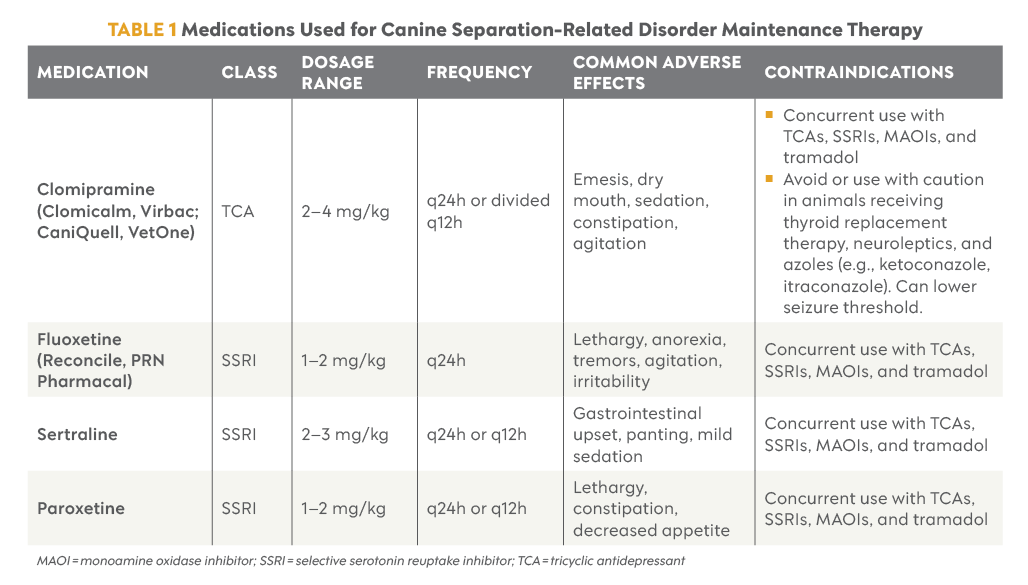
Maintenance therapy is a foundation of pharmacologic treatment and consists of daily medications prescribed with a goal of lowering the dog’s steady state of anxiety (TABLE 1). Clients should be counseled that medications typically require several weeks to achieve therapeutic levels. Because these drugs alter the density of receptors in the brain over time, consistency is paramount; skipping doses can disrupt the steady state. Any adverse effects are most likely to crop up during the first couple of weeks. The 2 classes most commonly prescribed are selective serotonin reuptake inhibitors (SSRIs) and tricyclic antidepressants (TCAs).
SSRIs
SSRIs specifically block the reuptake of serotonin in the synaptic cleft, increasing the availability of that calming neurotransmitter. Over time, SSRIs help downregulate overactive serotonin receptors and promote a more stable emotional state.
Reconcile (fluoxetine) is an SSRI manufactured by PRN Pharmacal and is licensed to treat separation anxiety in dogs. Other commonly prescribed SSRIs include sertraline and paroxetine, and adverse effects can include transient lethargy or decreased appetite. Client adherence to recommendations may be improved if medication is started at the lower end of the dosing range and gradually titrated up.6,7
TCAs
Unlike SSRIs, which are highly selective, TCAs inhibit the reuptake of serotonin and norepinephrine. TCAs can potentially be more beneficial for dogs that exhibit a high degree of reactivity, but they can also possibly lead to more adverse effects, often due to their anticholinergic effects (e.g., dry mouth leading to increased water consumption, constipation, urinary retention). They also are known to affect cardiac conduction and can potentiate seizures in seizure-prone animals.8
Clomipramine is available as Clomicalm (Virbac) and CaniQuell (VetOne), both of which are licensed to treat separation anxiety in dogs. Another TCA that has been used is amitriptyline, but its use has fallen out of favor as a first-line treatment due to the higher likelihood of adverse effects and lack of efficacy.
Situational Therapy
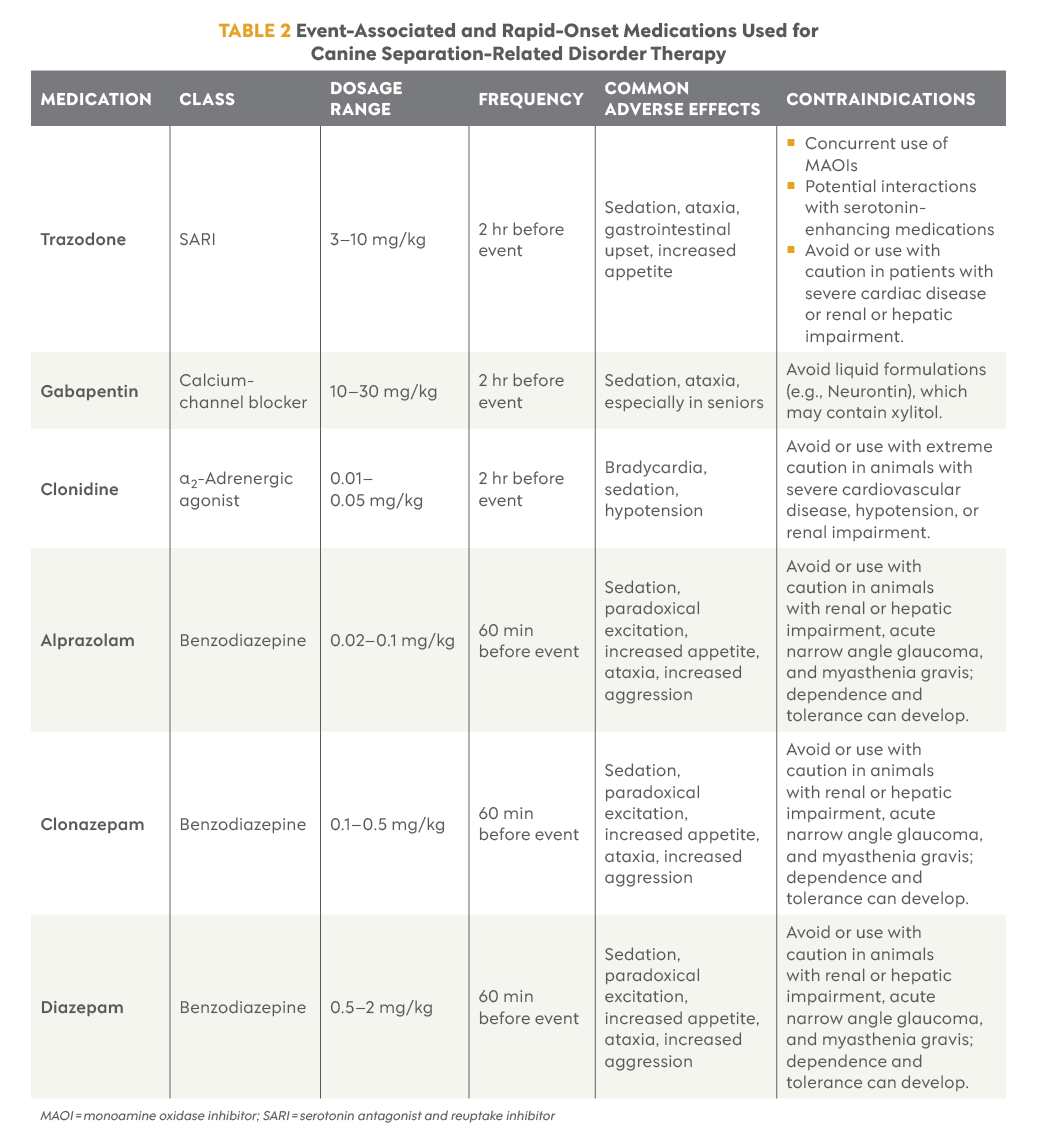
Maintenance therapy is rarely effective on its own, especially during the early stages of treatment for a patient that is experiencing panic attacks. The acute stress of its owner walking out the door can still trigger a panic attack in the dog. The goal of situational therapy is to prevent the spike of panic that occurs during those separation cues and events, providing a safety net while the maintenance medication builds up in the system. The medications are administered on an as-needed basis, timed to coincide with the owner’s departure (TABLE 2). To assess effectiveness, or lack thereof, a test dose while the owner is home is strongly suggested before the drug is used for actual departures.
Trazodone
Trazodone, perhaps the most recognized medication for this use, is a serotonin antagonist and reuptake inhibitor (SARI). It provides relatively rapid-onset anxiolysis. When dosed 60 to 90 minutes before owner departure, it can help blunt the peak of the dog’s panic. Compared with the more finite dosing ranges of SSRIs and TCAs, the dosing range for trazodone is wide.9,10
Gabapentin
Gabapentin is another rapid-onset medication used for events such as owner departures. Traditionally viewed as an anticonvulsant or as a treatment for neuropathic pain, its use at higher doses for anxiety has shown promise and provides anxiety relief with less reported sedation than trazodone.11
Clonidine
Clonidine is an α2 -adrenergic agonist that works by inhibiting the release of norepinephrine, effectively lowering the dog’s fight-or-flight response. Although clonidine is generally safe, it can significantly affect heart rate and blood pressure, as it inhibits norepinephrine.9,12
Benzodiazepines
If a dog is not responsive to the above-mentioned event medications, or if use of those medications is contraindicated, benzodiazepines such as alprazolam, diazepam, or clonazepam may be required.13 Benzodiazepines have GABAA (γ-aminobutyric acid A) receptor agonist effects but should be used with caution. Beyond the risk for physical dependence after long-term use, benzodiazepines can cause paradoxical excitation and disinhibition, which can be exhibited as hyperactivity or even aggression. Furthermore, because they can interfere with memory formation, benzodiazepines are less than ideal for use during active behavior modification sessions but may be beneficial when the dog does not remember the owner leaving.
Tasipimidine
A newly licensed medication, tasipimidine sulfate oral solution (Tessie, Orion Animal Health), has been approved for treatment of separation anxiety and noise phobia in dogs (although it is not yet available in the United States).14 It is a potent and selective full agonist of the human α2A-adrenergic receptor. It is meant to be given 1 hour before the dog is left alone and can be repeated 3 hours later if needed, up to 3 times in 24 hours.14
Combination Therapy
For many patients with an SRD, monotherapy fails. Therefore, there is a place for rational polypharmacy, a strategic layering of medications with different mechanisms of action.15 A dog might receive daily sertraline to help alleviate anxiety while receiving a combination of clonidine and gabapentin to mitigate panic attacks triggered by departures. However, other combinations (e.g., SSRI + trazodone or SSRI + clomipramine) are commonly used but are associated with a rare, but serious, risk for serotonin syndrome (BOX 1).
Common clinical signs:
- Agitation
- Tremors
- Hyperthermia
- Tachycardia
- Mydriasis
- Seizures
Weaning the Patient Off Medication
Pharmacotherapy for SRDs is not necessarily lifelong, although it may be for some dogs. Anxiety disorders are chronic illnesses requiring months, or even lifelong, therapy. Dogs with additional behavioral diagnoses, such as generalized anxiety, may never have a good quality of life without consistent use of antianxiety medications. Thus, weaning is a goal, not a requirement; for some pets, medications provide a necessary baseline for a good quality of life.
The weaning process must be undertaken slowly. A common mistake is stopping the medication abruptly, which can lead to a profound rebound of anxiety and a relapse of the associated behavior. Instead, the dose should be reduced by approximately 25% every 4 weeks; however, this recommendation is highly dependent on the length of time the dog has been receiving the medication(s). During each reduction phase, the client must be hypervigilant for the return of even the earliest hint of anxiety. If those signs return, the weaning process should be halted and the dog returned to the previous effective dose for a period before a slower weaning process is attempted, if it is even possible.
Summary
Medication for maintenance and situational therapy of SRD along with behavior modification helps provide the neurochemical stability needed to improve affected dogs’ quality of life. Use of these therapies does not just entail prescribing medications; it also preserves the human–animal bond and providing relief to patients who are trapped in their own fear.
References
- Dantas LM, Ogata N. Veterinary psychopharmacology. Vet Clin North Am Small Anim Pract. 2024;54(1):195-205. doi:10.1016/j.cvsm.2023.07.003
- Meneses T, Robinson J, Rose J, Vernick J, Overall KL. Development of and pharmacological treatment options and future research opportunities for separation anxiety in dogs. JAVMA. 2021;259(10):1130-1139. doi:10.2460/javma.20.10.0602
- Meneses T, Robinson J, Rose J, Vernick J, Overall KL. Review of epidemiological, pathological, genetic, and epigenetic factors that may contribute to the development of separation anxiety in dogs. JAVMA. 2021;259(10):1118-1129. doi:10.2460/javma.20.08.0462
- Ogata N. Separation anxiety in dogs: what progress has been made in our understanding of the most common behavioral problems in dogs? J Vet Behav. 2016;16:28-35. https://doi.org/10.1016/j.jveb.2016.02.005
- Terlizz, EP, Zablotsky B. Mental health treatment among adults: United States, 2019. NCHS Data Brief. 2020;380:1-8.
- Sherman Simpson BS, Landsberg GM, Reisner IR, et al. Effects of Reconcile (fluoxetine) chewable tablets plus behavior management for canine separation anxiety. Vet Ther. 2007;8(1):18-31
- Landsberg GM, Melese P, Sherman BL, Neilson JC, Zimmerman A, Clarke TP. Effectiveness of fluoxetine chewable tablets in the treatment of canine separation anxiety. J Vet Behav. 2008;3(1):12-19. https://doi.org/10.1016/j.jveb.2007.09.001
- King JN, Simpson BS, Overall KL, et al. Treatment of separation anxiety in dogs with clomipramine: results from a prospective, randomized, double-blind, placebo-controlled, parallel-group, multicenter clinical trial. Appl Anim Behav Sci. 2000;67(4):255-275. doi:10.1016/s0168-1591(99)00127-6
- Ciribassi JJ, Ballantyne. Using clonidine and trazodone for anxiety-based behavior disorders in dogs. dvm360. March 31, 2014. Accessed May 25, 2026. https://www.dvm360.com/view/using-clonidine-and-trazodone-anxiety-based-behavior-disorders-dogs
- Gruen ME, Sherman BL. Use of trazodone as an adjunctive agent in the treatment of canine anxiety disorders: 56 cases (1995–2007). JAVMA. 2008;233(12):1902-1907. doi:10.2460/javma.233.12.1902
- Kirby-Madden T, Waring CT, Herron M. Effects of gabapentin on the treatment of behavioral disorders in dogs: a retrospective evaluation. Animals (Basel). 2024;14(10):1462. doi:10.3390/ani14101462
- Ogata N, Dodman NH. The use of clonidine in the treatment of fear-based behavior problems in dogs: an open trial. J Vet Behav. 2011;6(2):130-137. https://doi.org/10.1016/j.jveb.2010.10.004
- Herron ME, Shofer FS, Reisner IR. Retrospective evaluation of the effects of diazepam in dogs with anxiety-related behavior problems. JAVMA. 2008;233(9):1420-1424. doi:10.2460/javma.233.9.1420
- FDA approves first drug to treat noise aversion and separation anxiety in dogs. U.S. Food and Drug Administration. May 6, 2026. Accessed May 8, 2026. https://www.fda.gov/animal-veterinary/cvm-updates/fda-approves-first-drug-treat-noise-aversion-and-separation-anxiety-dogs
- Ibáñez M, Anzola B. Use of fluoxetine, diazepam, and behavior modification as therapy for treatment of anxiety-related disorders in dogs. J Vet Behav. 2009;4(6):223-229. https://doi.org/10.1016/j.jveb.2009.04.001