

Historically, diversity, equity, and inclusion have not been prioritized in veterinary medicine. Let’s be honest—this topic is often the “elephant in the room” when discussing the future of the profession. In 2024, 92.6% of veterinarians and 87.5% of veterinary technologists/technicians identified as White and 68.6% and 86.2%, respectively, identified as female.1 The undeniable lack of diversity can best be addressed through education and pathway programs. Yet sustainable funding, socioeconomic barriers, and limited access make implementation difficult. Inclusive mentorship, retention, and representation are equally critical for success. Beyond the moral and ethical imperative, there are various benefits for a more diverse, equitable, and inclusive workplace: Workplaces with greater diversity report higher job satisfaction, stronger motivation, and longer employee retention, according to the 2025 NAVTA Diversity, Equity, Inclusion, and Belonging Landscape Survey.2
This article is brought to you in collaboration with Pawsibilities Vet Med as part of a 6-part series, Prosperity Perspectives: Building a Thriving Veterinary Community.
The industry is beginning to acknowledge the lack of diversity and the resources, mentorship, and accountability needed to make impactful change. Acknowledgment alone is not enough, as change goes beyond outdated procedures, protocols, or videos. Veterinary professionals understand the importance of measurable and attainable skill sets. The question is: How do we engage in ways that truly benefit future professionals? The answer lies in how their journey begins.
My Introduction to Veterinary Medicine
My introduction to the veterinary industry was far from ideal. I was fired from my first job in the field. Like many, I started in the kennel—walking dogs, feeding animals, cleaning kennels and cat condos, and administering medications—with no prior experience. I had never been trained to give medications, yet I was expected to do so. Mistakes led to verbal reprimands and written warnings, but there was no training, clear procedures, or mentor to guide me.
When I began veterinary technology school, I was simply told, “You got this!” and thrown into the treatment area of the hospital, but again, there was no support or structured training. I quickly noticed I was the only person of color in the clinic. After a few mistakes, I was fired without counsel or retraining. It became clear that I would have to fight my way through this journey alone.
For nearly 2 decades, I continued to find myself in a variety of veterinary settings that lacked training and mentorship. Hands-on opportunities were limited, and professional development was absent. Who is responsible for ensuring training, teaching, and growth? Who takes accountability when team members and patients suffer?
Veterinary Pipeline Programs for the Youth
Pipeline and pathway programs are structured, sequential, and often multistage programs designed to guide individuals into specific professional fields. They offer exposure; mentoring; training; and academic, and sometimes monetary, support to create diverse, qualified professionals.
Research shows that representation has a profound impact on children envisioning themselves in a career.3 Thus, since children are less likely to see diverse representation in the veterinary field, they are also less likely to envision themselves in the field or go on to seek mentorship and guidance from someone who does not have the same background as them. While “critical mentorship considers the context of the social identities of both mentors and mentees [as] related to race, ethnicity, gender, sexual orientation, and class … these identities do not have to be shared by the mentors or mentees, but they are a focus of the design and functioning of the mentoring relationship.”4 Beyond childhood, where interest is cultivated and nurtured, many individuals from marginalized communities still face obstacles obtaining higher education.5
Recently, multiple areas of the veterinary industry have started addressing the lack of representation in the field via targeted pipeline and pathway programs. There are a multitude of organizations dedicated to this very issue (TABLE 1). Additionally, many higher-education institutions are now involved in pipeline programs. There are 59 AVMA-accredited colleges of veterinary medicine throughout the world and many have their own program(s) aimed at attracting and retaining interested and talented individuals (TABLE 1).
Articulation agreements are also helpful pathways for students. These occur between select veterinary colleges who partner with other universities and schools to offer dedicated seats and/or benefits to students from certain programs (TABLE 1). Articulation agreements ensure students are obtaining base-level education without the price tag of a more expensive state school and are also given an equitable chance at veterinary medical and technology school interviews and admission.
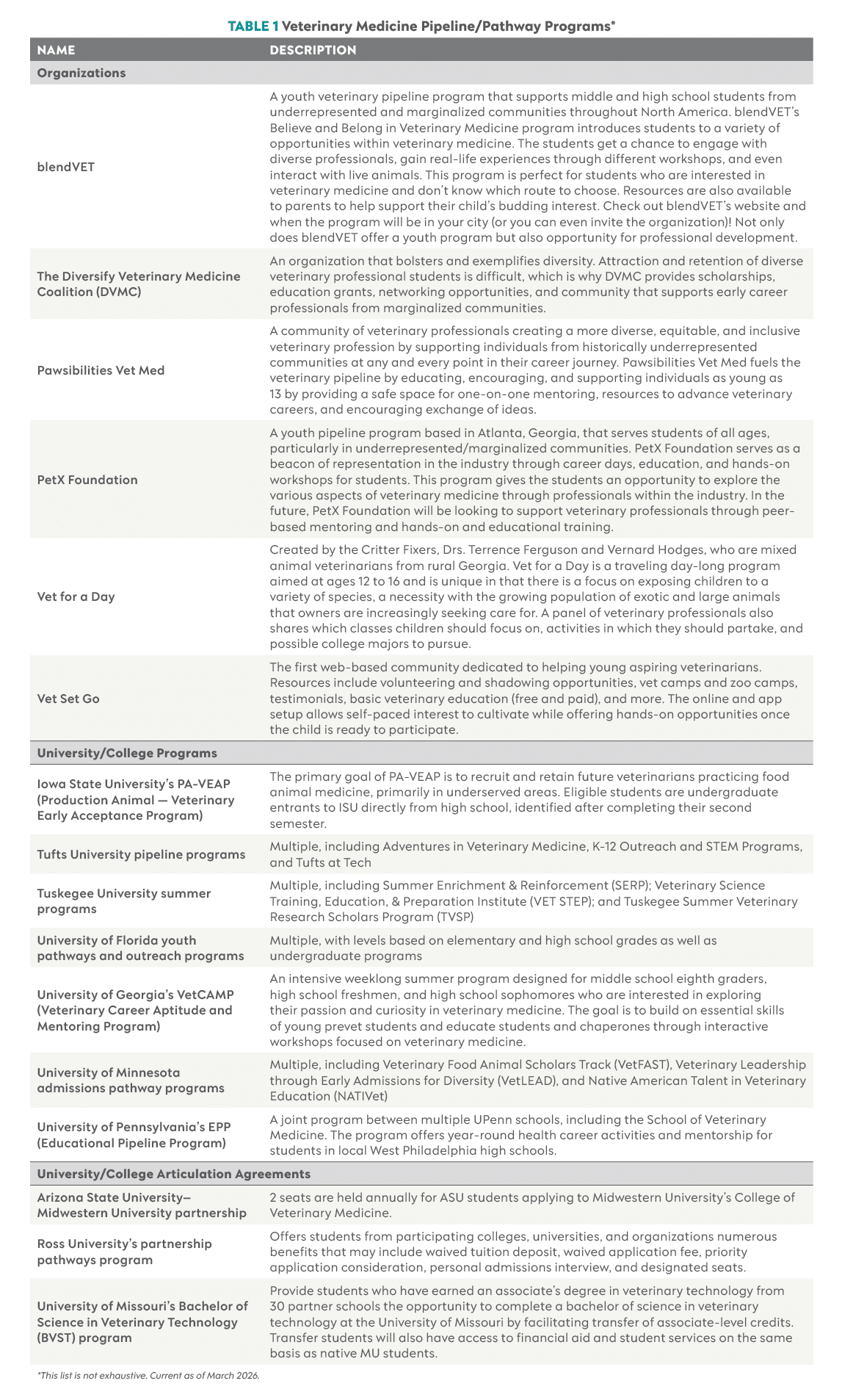
Download a PDF of this table to share online and in the clinic.
It would be remiss to leave out mention of veterinary assistant and nurse/technician programs. Early education pathway programs and events are aiming to expose children to the overall veterinary medicine profession, and a vital part of the veterinary team are veterinary assistants and veterinary nurses/technicians. Pathway programs should educate on each of the associated roles within the profession. Veterinary assisting/nursing/technology may also be a more accessible career, with over 200 veterinary technology programs in the U.S. accredited by the AVMA CVTEA and online, hybrid, or in-person certifications to become an Approved Veterinary Assistant (NAVTA) or Certified Veterinary Assistant (state-specific programs).
Industry Support of the Veterinary Pipeline and Diversity
Change can be slow when it starts at the bottom, with individuals and small groups. That is why it is crucial for those at the top—corporations and large-scale companies, many worth millions or billions of dollars—to invest time and money in underrepresented communities, support trailblazing leaders, and provide educational materials. Doing so not only uplifts the communities that have long been overlooked but also ignites a ripple effect of possibility—unlocking new voices, new ideas, and new leaders who will shape a brighter, more inclusive future. Industry partners can contribute to diversifying the field in a variety of ways (BOX 1).
Smaller organizations that may not have the capital of group hospitals or pharmaceutical corporations can still support those building pathway development. Organizations such as Maddie’s Fund and Black Pet Business Network offer grants and funding as well as mentorship, partnerships, and networking opportunities.
- Inclusive hiring practices to boost representation in the field
- Shadowing and mentoring opportunities to those who are interested
- Contributing to scholarship funds and educational grants
- Partnering with local clinics, shelters, and rescues to increase exposure and mentorship opportunities
- Collaborating with and supporting foundations and grassroots initiatives that provide targeted action to alleviate the constant stress of self-funding
Hiring and Retaining Diverse Veterinary Leaders
Change starts locally. Challenge your institution to hire leaders with diverse backgrounds, focusing on individuals who reflect the communities they serve, especially in roles tied to teaching, recruiting, and outreach. The AAVMC’s wellbeing initiatives show that diverse faculty and staff encourage student bodies to mirror their institutions.6 With staffing shortages across the industry, why not hire individuals with leadership potential who can grow into multiple roles? Provide them with training, tools, and support—even if sourced externally.
Inclusive mentors foster trust and positive learning experiences.7 On a corporate scale, intentional diversity hiring should be standard. Establish a core curriculum, designate trainers, conduct quarterly check-ins, and survey both students and trainers to ensure progress and meet needs. One example includes the MentorVet Tech program, which equips veterinary technicians and other professionals with the proper tools to strengthen their leadership skills, handle challenges in the workplace, and recognize their points of personal and professional growth. Another example is Pawsibilities Vet Med, a virtual community that supports all levels of professionals by providing training, education, mentorship, tools, and resources for professional development. The wider community can support these organizations through funding and volunteering.
Veterinary Training and Resources
Ongoing training and accessible resources must be a priority to sustain a diverse workforce in veterinary medicine. Unfortunately, historically marginalized communities often lack these resources. This disparity is known as the socioeconomic achievement gap, measured by race, ethnicity, social class, and gender.8 Communities with greater access can offer dual enrollment programs, internships, and external training opportunities. Narrowing this gap will ensure a wider range of individuals will have the chance to explore their interest in veterinary medicine.
When employees receive training, productivity increases.9 Additionally, 59% of employees believe training directly enhances their performance.9 AtDove is a great resource for practices to invest in for upskilling employees at all levels that are looking for advancement. The AVMA has organized a set of skillsets that can be a guide for all stages of employment.10 Resources such as the 2023 AAHA Technician Utilization Guidelines can ensure practices are allowing credentialed staff to work at the height of their abilities.11 Additionally, stipends and PTO should be provided to all members of the veterinary team to obtain continuing education—from kennel techs who may want to become an approved veterinary assistant to veterinary technicians who may want to purse a VTS credential.
Action Drives Change
Acknowledging the lack of diversity in veterinary medicine is only the first step. Taking action is what drives change (BOX 2). DVMC has given me numerous opportunities for mentorship and networking. Through MentorVet Tech, I have learned how to become a better leader, be aware of myself mentally in the workplace, and further my career. This opportunity has given me the courage to be a facilitator in that same program and lead others to better navigate in a healthy space!
- Volunteering with an existing grassroots organization
- Beginning a shadowing or pipeline program in your own hospital
- Traveling to marginalized areas of your region and host career days to schools
- Providing resources in your clinic to give to interested kids, such as local college programs, online communities like Vet Set Go, and a list of scholarship funds
- Ensuring all levels of team members are aware of their mentoring opportunities, utilization skillsets, and upskilling opportunities
Progress may be slow, but allies, community support, passion, and dedication are key to closing the socioeconomic achievement gap and attracting and retaining individuals from underrepresented communities in the veterinary industry. Allies can help secure opportunities, funding, and structural education programs. Leaders and educators with a diverse background will foster inspiration and growth among students. Providing resources will open doors to the many opportunities within veterinary medicine.
Change begins in your community.
References
- Labor force statistics from the current population survey. U.S. Bureau of Labor Statistics. Updated January 29, 2025. Accessed February 13, 2026. https://www.bls.gov/cps/cpsaat11.htm
- Loftin CM, Ramirez M, Wheeler P, Baez J, Tesch B. Where We Stand: NAVTA’s Diversity, Equity, Inclusion, and Belonging Landscape Survey. National Association of Veterinary Technicians in America. 2025. Accessed December 19, 2025. https://drive.google.com/file/d/1cIn7IojkkPYbu34HABhz1WRWSk-9YLEh/view
- Chambers N, Kashefpakdel ET, Rehill J, Percy C. Exploring the career aspirations of primary school children from around the world. Education and Employers. January 2018. Accessed February 13, 2026. https://www.educationandemployers.org/wp-content/uploads/2018/01/DrawingTheFuture.pdf
- Quicksall MS. Inclusive mentorship for the next generation of veterinary professionals. Vet Clin North Am Small Anim Pract. 2024;54(6):869-880. doi:10.1016/j.cvsm.2024.07.014
- Thiem KC, Dasgupta N. From precollege to career: Barriers facing historically marginalized students and evidence‐based solutions. Soc Issues Policy Rev, 2022;16(1):212-251. https://doi.org/10.1111/sipr.12085
- Integrating racial & multicultural inclusion into academic wellbeing initiatives. American Association of Veterinary Medical Colleges. July 2020. Accessed December 19, 2025. https://www.aavmc.org/wp-content/uploads/2023/04/AAVMC-Wellbeing-Integrating_Inclusion-01.pdf
- Quicksall MS. Inclusive mentorship for the next generation of veterinary professionals. Vet Clin North Am Small Anim Pract. 2024;54(6):869‑880. doi:10.1016/j.cvsm.2024.07.014
- Bradley K. The socioeconomic achievement gap in the US public schools. Ballard Brief. December 2022. Accessed December 19, 2025. https://scholarsarchive.byu.edu/ballardbrief/vol2022/iss3/10
- Pappas C. Employee training statistics, trends, and data in 2025. eLearning Industry. June 3, 2025. Accessed January 4, 2026. https://elearningindustry.com/employee-training-statistics-trends-and-data
- CVTEA accreditation policies and procedures. AVMA. Updated February 2026. Accessed February 26, 2026. https://www.avma.org/education/center-for-veterinary-accreditation/committee-veterinary-technician-education-activities/cvtea-accreditation-policies-and-procedures-appendix-g
- 2023 AAHA Technician Utilization Guidelines. AAHA. September 30, 2023. Accessed February 6, 2026. https://www.aaha.org/resources/2023-aaha-technician-utilization-guidelines