
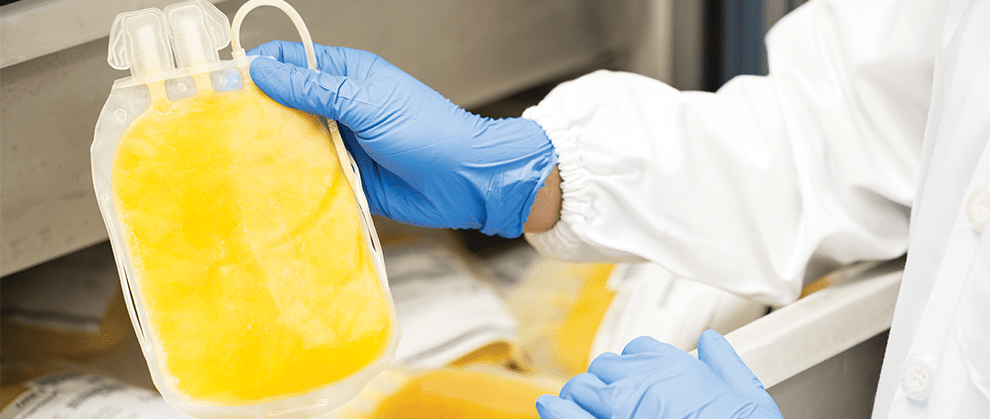
Transfusion medicine has become fairly commonplace in veterinary medicine. There are relatively few platelet-containing products, and they are often expensive with short-lived effects. Thus, platelet administration, when the platelet count is low or the platelets are not functioning normally, remains challenging. Understanding when to consider or pursue platelet transfusion is valuable for general practitioners.
Take-Home Points
- Compared with red blood cell and plasma transfusion, platelet transfusion is more challenging because product is less available and more expensive and efficacy is not well documented.
- The threshold for platelet transfusion is not based on platelet count alone; rather, the current or anticipated clinical signs associated with the low platelet count should be considered.
- Platelet transfusion is typically reserved for patients with life-threatening hemorrhage or for patients with platelet abnormalities about to undergo a planned invasive procedure.
Platelets are often thought of as relatively inert particles that aggregate to form a plug at sites of vascular injury; however, their role in hemostasis is far more complex. Platelets play an active role in hemostasis, expressing approximately 30 surface receptors.1 After they have been activated, platelets change shape, release procoagulant molecules, and alter their surface membrane to create a procoagulant surface.1,2 Activated platelets can alter their shape to increase their surface area by approximately 400%.1 Platelets contain granules with dozens of bioactive compounds that serve a variety of functions in hemostasis, including promotion of further fibrin formation, which helps build and stabilize the developing clot.1 Also relevant to hemostasis is transformation of the platelet membrane to a procoagulant surface because it provides a scaffold that concentrates and activates coagulation factors at the injury site.1,2 This article covers the most commonly encountered questions regarding platelet transfusions.
Q: What conditions are likely to necessitate platelet transfusion?
Acquired thrombocytopenia is a common abnormality in small animal medicine3 and can result from increased platelet consumption (resulting from clot formation), immune-mediated destruction, decreased production, or sequestration. Common causes of severe thrombocytopenia are primary and secondary immune thrombocytopenia, especially when platelet counts fall below 20 × 103/µL.4 Other systemic conditions such as uremia, liver disease, and heart disease can result in decreased platelet function or thrombocytopathia.3 Drugs, particularly antiplatelet and antithrombotic drugs, can affect platelet function. Last, although relatively rare, some congenital disorders result in thrombocytopathia.3,5
Q: When should a platelet transfusion be considered?
May not be indicated
In most patients with an otherwise intact hemostatic system, spontaneous bleeding resulting from thrombocytopenia may occur when platelet counts are less than 20 to 30 × 103/µL.3,6 Clinically, platelet count alone does not reliably predict the presence or severity of bleeding because many animals with severe thrombocytopenia do not exhibit life-threatening hemorrhage.5-7 Therefore, as with transfusion considerations for patients with anemia, platelet transfusion is not recommended based on platelet count alone.5 The American College of Veterinary Internal Medicine consensus statement on the treatment of immune thrombocytopenia recommends against routine platelet transfusions in dogs and cats.4 Given the higher cost, unclear efficacy, and limited availability of platelet-containing products, it is often more practical and cost-effective to treat blood loss in thrombocytopenic patients with packed red blood cell transfusions rather than pursue repeated platelet transfusions alone to try and prevent hemorrhage.
In addition to limited availability, the efficacy of platelet transfusion is not well documented in veterinary medicine. No prospective trials have compared outcomes among thrombocytopenic veterinary patients that did and did not receive platelet products. Such studies are often difficult to perform due to equipoise. In a retrospective case–control study, thrombocytopenic dogs that received cryopreserved platelet concentrate experienced a transiently increased platelet count but no improvement in clinical bleeding or survival rates.8 The lifespan of transfused platelets is also relatively short. In healthy dogs, platelets from fresh platelet concentrate have a half-life of around 3.8 days.9 In animals with immune thrombocytopenia, the half-life is likely even shorter.
May be indicated
During severe or life-threatening hemorrhage: When platelet count progressively decreases, the risk for life-threatening hemorrhage increases.3 Transfusion of platelet-containing products is indicated for patients with thrombocytopenia or thrombocytopathia that are experiencing severe or life-threatening hemorrhage.5,7 There is no single or consensus definition of severe hemorrhage; however, it may be defined as the need for recurrent red blood cell transfusions, particularly over a short period. Life-threatening bleeding is typically defined as hemorrhage into vital organs (e.g., central nervous system, lungs, myocardium).7 Although bleeding into the gastrointestinal or urogenital tract is undesirable, timely red blood cell transfusion often prevents fatal outcomes. In contrast, hemorrhage involving the central nervous system or lungs can rapidly become fatal as those organs have limited functional reserve to tolerate hemorrhage. Therefore, hemorrhage into vital organs warrants platelet transfusion to try and halt the bleeding rather than just replacing the lost red blood cells. Note, however, that although clinical resolution of bleeding may occur, platelet transfusion may not appreciably increase platelet count.3
Before invasive procedures: When invasive procedures (e.g., central line placement, percutaneous biopsies) and/or surgery are planned, platelet counts should ideally be greater than 50 × 103/µL,6 and higher counts may be preferred. Planned invasive procedures (e.g., cavity surgery) may warrant platelet transfusion based on platelet count alone.5-7 Patients for which surgery is planned should have a platelet count of at least 50 × 103/µL to avoid excessive hemorrhage associated with intrasurgical tissue trauma. Although platelet transfusion before a planned procedure is recommended, waiting for a documented increase in platelet count is not typically recommended as the increase may be limited or may not occur.3 One exception is congenital macrothrombocytopenia, which is most common among Cavalier King Charles and toy spaniels and results in platelet numbers significantly below normal and platelets that are significantly larger than normal. Genetic testing is available to diagnose this condition.6 However, despite decreased platelet numbers, these dogs do not experience increased clinical bleeding.
Q: What platelet-containing products are available?
Specific platelet-containing products are available for dogs but not for cats.
Dogs
Fresh whole blood: Fresh whole blood is blood obtained from a healthy donor and used, without refrigeration, within 8 hours of collection.10 By definition, fresh whole blood must be collected (and used) on demand; it cannot be stored, which requires a clinic to have access to readily available, health-screened donors. The product should have a platelet count approximately the same as that of normal blood. Transfusing 10 mL/kg of fresh whole blood is expected to raise the platelet count of the recipient by approximately 10 × 103/µL.4,7
Stored whole blood: Stored whole blood is whole blood that has been stored at refrigerator temperature (4 °C [39 °F]) more than 8 hours from collection. Red blood cells are considered viable for 28 to 42 days from the date of collection, depending on the preservative solution used.3,7 Studies of dogs have demonstrated that hemostatic capability in stored whole blood is preserved for up to 28 days11; studies evaluating longer storage times have not been performed. Stored whole blood provides live, active platelets. Stored whole blood can be kept refrigerated for several weeks, allowing it to be available on-hand rather than requiring on-demand collection. Stored whole blood is commercially available from veterinary blood banks, and administration dosage is similar to that for fresh whole blood.
Platelet-rich plasma and platelet concentrate: Platelet-rich plasma is created by centrifuging fresh whole blood at a slower speed, which leaves platelets largely suspended in plasma while still packing the red blood cells. If desired, the platelets can be further concentrated into a smaller volume of plasma, called platelet concentrate.12 Platelet-rich plasma must be stored at room temperature with constant, gentle agitation and has a shelf life of 5 days.10 Due to the short duration of storage, platelet-rich plasma is not readily available at most blood banks. Some banks will produce it upon request; however, this still results in a 24- to 48-hour ordering-to-delivery delay. The dose is 1 unit of platelet-rich plasma or platelet concentrate per 10 kg (22 lb) of body weight.3,7
Cryopreserved platelet concentrate: Platelet concentrate, stored with dimethyl sulfoxide and frozen for up to 1 year, is commercially available from select blood banks; however, platelet viability and post-transfusion function remain incompletely understood. In vitro studies have demonstrated that the platelets can be activated after thawing, although only about half as well as those in fresh platelet concentrate.9 The in vivo survival rate for cryopreserved platelets (49%) is also less than that for fresh platelet concentrate (80%), and the half-life of cryopreserved platelets is shorter (approximately 1.9 days).9 Dosing is similar to that of platelet-rich plasma or platelet concentrate.
Lyophilized platelets: Platelet concentrate can be subjected to a freeze-drying process to produce lyophilized platelets.7 Although this product was commercially available, it is not currently produced.
Cats
Due to the relatively small volume of blood units that can be collected from cats, as well as other challenges associated with platelet product preparation, there are no specific platelet-rich blood products commercially produced for cats. Fresh and stored (likely) whole blood can be used as a source of platelet transfusion in cats; however, the viability of stored platelets in cats has not been evaluated as it has been in dogs.4 Transfusion of canine blood components to cats has been reported,13 and in extenuating circumstances, the author has used canine cryopreserved platelet concentrate and lyophilized platelets in cats.14
Q: Are there alternatives to platelet transfusion?
The answer to this question depends on the underlying condition. Some disorders affecting platelet adhesion, such as von Willebrand disease, result from von Willebrand factor deficiency rather than intrinsic platelet dysfunction and may be managed with plasma and/or desmopressin. Use of antifibrinolytic drugs (e.g., tranexamic acid, aminocaproic acid) is likely reasonable during active hemorrhage or before planned invasive procedures in a patient with thrombocytopenia or thrombocytopathia. These drugs do not promote clot formation but help prevent the breakdown of a clot after it forms.3,4 Although clinical veterinary studies are not available for many such drugs in the setting of platelet dysfunction, the risk seems to be low and they are relatively inexpensive. However, for some clinically bleeding patients, replacement of other blood factors, such as red blood cells and/or plasma, and essentially ignoring the platelets may be more cost effective and readily available.
Summary
Given the essential role that platelets play in hemostasis, it is reasonable to consider them as potential therapeutic targets in the presence of thrombocytopenia or thrombocytopathia. Although platelet transfusion may be considered for patients with hemorrhage or thrombocytopenia, its use is constrained by availability of functional platelets, cost, and the potential for transfusion reactions. Therefore, potential benefits versus risks should be carefully considered for each patient.
References
- Goggs R, Poole AW. Platelet signaling – a primer. J Vet Emerg Crit Care (San Antonio). 2012;22(1):5-29. doi:10.1111/j.1476-4431.2011.00704.x
- Smith SA. The cell-based model of coagulation. J Vet Emerg Crit Care (San Antonio). 2009;19(1):3-10. doi:10.1111/j.1476-4431.2009.00389.x
- Li RHL. Platelet disorders. In: Silverstein DC, Hopper K, eds. Small Animal Critical Care Medicine. 3rd ed. Elsevier; 2023:599-607.
- LeVine DN, Goggs R, Kohn B, et al. ACVIM consensus statement on the treatment of immune thrombocytopenia in dogs and cats. J Vet Intern Med. 2024;38(4):1982-2007. doi:10.1111/jvim.17079
- Scott MA, Jutkowitz A. Immune-mediated thrombocytopenia. In: Weiss DJ, Wardrop KJ, eds. Schalm’s Veterinary Hematology. 6th ed. Wiley-Blackwell; 2010:586-595.
- Shropshire S, Brainard B. Coagulation disorders and surgery. In: Monnet E, ed. Small Animal Soft Tissue Surgery. 2nd ed. John Wiley & Sons, Inc.; 2023:905-916.
- Muslin S. Transfusion medicine. In: Silverstein DC, Hopper K, eds. Small Animal Critical Care Medicine. 3rd ed. Elsevier; 2023:409-415.
- Ng ZY, Stokes JE, Alvarez L, Bartges JW. Cryopreserved platelet concentrate transfusions in 43 dogs: a retrospective study (2007-2013). J Vet Emerg Crit Care (San Antonio). 2016;26(5):720-728. doi:10.1111/vec.12503
- Appleman EH, Sachais BS, Patel R, et al. Cryopreservation of canine platelets. J Vet Intern Med. 2009;23(1):138-145. doi:10.1111/j.1939-1676.2008.0225.x
- Abrams-Ogg ACG, Schneider A. Principles of canine and feline blood collection, processing, and storage. In: Weiss DJ, Wardrop KJ, eds. Schalm’s Veterinary Hematology. 6th ed. Wiley-Blackwell; 2010:731-737.
- Edwards TH, Darlington DN, Pusateri AE, et al. Hemostatic capacity of canine chilled whole blood over time. J Vet Emerg Crit Care (San Antonio). 2021;31(2):239-249. doi:10.1111/vec.13055
- Saint-Pierre LM, Farrell KS, Hopper K, Reagan KL. Retrospective evaluation of fresh platelet concentrate administration in dogs: patient characteristics, outcomes, and transfusion practices in 189 transfusion episodes (2008–2019). J Vet Emerg Crit Care (San Antonio). 2023;33(3):360-370. doi:10.1111/vec.13281
- Elkin M, Amichay-Menashe N, Segev G, et al. Retrospective study of canine blood xenotransfusion compared with type-matched feline blood allotransfusion to cats: indications, effectiveness, limitations, and adverse effects. J Feline Med Surg. 2003;25(7):1098612X231183930. doi:10.1177/1098612X231183930
- Manucci E, Blong A, Zorn C, Walton R. Case report: Xenotransfusion of canine lyophilized platelets for hemostasis in a feline patient with post-operative abdominal hemorrhage. Front Vet Sci. 2023;10:1113846. doi:10.3389/fvets.2023.1113846