

Management of chronic enteropathy syndrome is common yet often challenging in small animal practice due to the variability in clinical presentation, underlying pathology, and response to therapy. A recent collaborative discussion among veterinary nutrition and internal medicine specialists highlighted the need for a more structured, diet-first, and patient-centered approach to management.
Take-Home Points
- Not all patients with chronic enteropathy or protein-losing enteropathy respond to the same dietary strategy; successful management often requires an individualized, nutrient-focused approach.
- Valuable diagnostic insight can be gained by carefully evaluating diet history, calorie intake, body weight trends, and subtle clinical signs.
- Diet is often among the most effective first-line interventions for patients with chronic enteropathy and protein-losing enteropathy and should be optimized before escalating medical therapy.
Current classification systems may oversimplify both chronic enteropathy (CE) and protein-losing enteropathy (PLE), which likely represent heterogeneous clinical syndromes with multiple underlying mechanisms that may differ substantially among patients. In addition, common clinical assumptions, such as interpreting response to hydrolyzed diets as confirmation of food hypersensitivity, may be overly simplistic and limit effective long-term management of dogs with chronic gastrointestinal disease. Considering how factors such as fat content, fiber, digestibility, and energy balance influence clinical response is important when interpreting the response to diet. In addition, careful attention to diet history, calorie intake relative to body condition, and subtle clinical signs (e.g., weight changes, behavioral patterns such as pica) can be helpful in identifying patients with less obvious signs.
By incorporating a structured, nutrient-focused approach to diet trials, clinicians can identify diet-responsive disease while also creating an individualized diet plan for the patient. Diet is not simply a single component of therapy but is a foundational tool for achieving long-term control of chronic enteropathy.
This article summarizes the key dialogue points from a discussion of the nutritional management of gastrointestinal disease conducted among a group of internists and nutritionists from around the world, called Bridging Communication Between Veterinary Nutrition and Gastroenterology, on April 20 and 21, 2026, hosted by Texas A&M University. The discussion emphasized the need for a more structured, diet-first, and patient-centered approach that better reflects the underlying complexity of chronic gastrointestinal disease. This article focuses on the main points of that discussion: a diet-first approach for dogs with CE and PLE and the complexities of managing patients with these syndromes.
Classification Challenges
One of the key challenges with diagnosing and managing chronic gastrointestinal disease that was identified by the group was the limitation of the current classification system, particularly the tendency to group chronic inflammatory enteropathy (CIE) and PLE together as relatively uniform disease processes. However, PLE may be more appropriately viewed as a separate clinical syndrome rather than simply a more severe form of CE, as the underlying mechanisms driving intestinal protein loss can differ substantially among patients. Classifying PLE as a severe form of CE can obscure these differences and may contribute to inconsistent treatment responses. CE and PLE patients may have varying degrees of intestinal inflammation, dysbiosis, malabsorption, epithelial barrier dysfunction, lymphatic dysfunction, and chronic mucosal remodeling, which likely contribute to the variability seen in clinical presentation and treatment response.1
Therapy Challenges
Recognizing the underlying complexity of CE and PLE helps explain why dietary intervention is often such a valuable first step in management and why the benefit of nutritional therapy likely extends beyond antigen reduction alone. Although dietary intervention should remain a foundational component of management, many patients ultimately require a combination of nutritional and medical therapies, highlighting the limitations of terms such as “food-responsive enteropathy,” which may oversimplify the multifactorial nature of CE and PLE.
Although both CE and PLE may warrant an initial diet trial, the underlying mechanism driving protein loss should guide the nutritional strategy. For example, patients with more severe lymphatic dysfunction may require early and aggressive fat restriction, whereas others may respond to hydrolyzed or novel protein diets. Although medical therapy remains valuable for some patients, research findings emphasize that early, carefully tailored dietary intervention is often among the most effective first steps in management.
Chronic Enteropathy
CE is a common syndrome managed in small animal practice, yet it can be frustrating to treat due to its variability in clinical presentation and response to therapy. During the recent collaborative discussion, a consistent theme emerged: While diagnostics and therapeutics continue to evolve, nutrition should remain the foundation of management rather than a secondary consideration.
Protein-Losing Enteropathy
Emerging clinical experience and expert consensus suggest that PLE may be more appropriately viewed as a separate clinical syndrome rather than simply a more severe form of CE. In human medicine, PLE has been associated with more than 60 conditions, and lymphatic disorders are further subdivided into distinct categories based on pathophysiology and clinical behavior. Applying a similar framework to dogs could help explain why patients with PLE can look similar clinically but respond very differently to treatment.
Emerging evidence supports this perspective. Work from Jablonski highlights the value of a diet-first, individualized approach to managing canine PLE.2 In a prospective study of 10 dogs with steroid-resistant PLE, dietary modification as the sole therapeutic change resulted in complete clinical remission in 8 dogs, and improvement was typically observed within 14 to 28 days.3 Although study numbers were small, the consistency and magnitude of response are clinically compelling and suggest that some cases of steroid-refractory PLE may respond to dietary modification alone without an increase in immunosuppressive therapy or the addition of other medication. The observed responses also highlight the value of tailoring nutritional management to the individual patient rather than relying on a single standardized dietary approach.
Food-Responsive Enteropathy
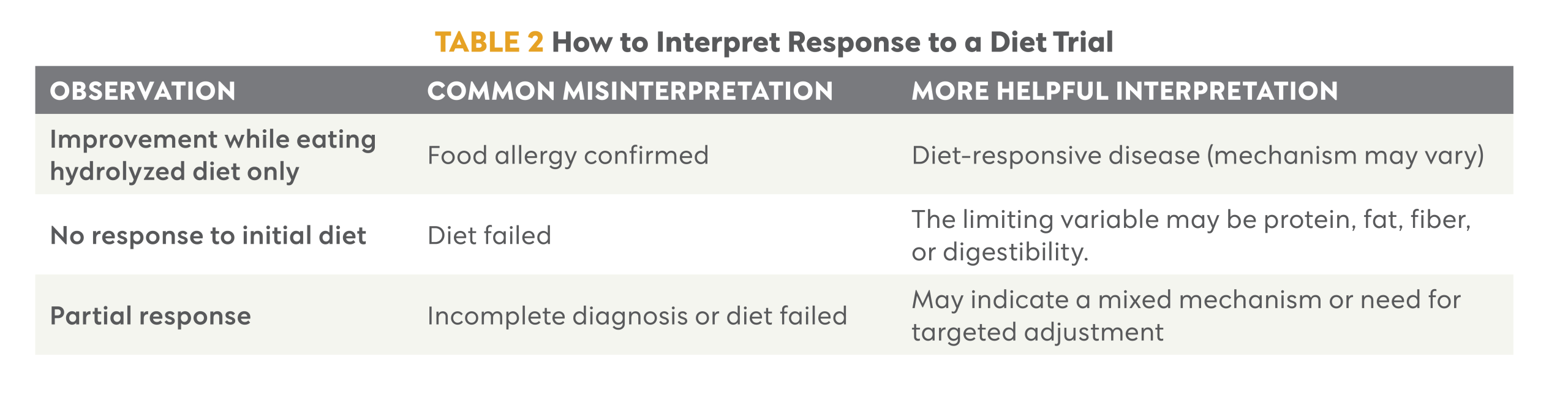
The group also revisited the concept of food-responsive enteropathy, which has historically been a useful clinical category but may oversimplify a more complex interaction between diet, host, and microbiome dysbiosis. In practice, improvement while eating a trial diet, particularly a hydrolyzed protein diet, is often interpreted as evidence of food hypersensitivity. However, this assumption may be overly simplistic. In practice, a response to a hydrolyzed diet should guide management but should not be used alone to define the underlying disease or permanently restrict dietary options.
Rather than focusing on terminology, the group’s discussion shifted toward a more practical question: Why do so many patients improve when fed hydrolyzed diets? Although reduced antigenic stimulation has traditionally been considered the primary mechanism, this explanation may be incomplete.
A randomized, open-label, positively controlled field trial compared the efficacy of a hydrolyzed protein diet with that of a highly digestible control diet in dogs with chronic small bowel enteropathy.4 Although short-term response rates were similar between groups, long-term outcomes were significantly better for dogs fed the hydrolyzed diet and included sustained remission of clinical signs and greater reductions in disease severity scores over time. These findings suggest that the benefit of hydrolyzed diets may extend beyond simple antigen reduction and may involve broader effects on intestinal function, digestion, or the microbiome. Clinically, these findings lead to a shift in thinking. A positive response to a hydrolyzed diet should not be interpreted as definitive evidence of food hypersensitivity, and doing so may lead to overly narrow or unnecessary long-term dietary restrictions.
Patient History
Diet
A particularly relevant area of discussion was the value of collecting and interpreting diet histories, as diet information can often provide early and clinically meaningful insight into gastrointestinal disease. In many cases, subtle features may historically precede overt clinical signs but are easy to miss if the right questions are not asked.
A comprehensive diet history extends beyond simply documenting the current diet. Careful review of previous diets and dietary interventions can provide valuable clues regarding disease mechanisms and can guide subsequent diet selection. Particular attention should be paid to whether clinical signs improved or worsened with specific diets, how those diets differed in nutrient composition (e.g., fat content, fiber content, digestibility, protein source), and whether dietary changes were implemented before or after the onset of clinical signs. All treats, supplements, table foods, chews, and other foods offered should be documented as these may contribute to clinical signs or confound interpretation of diet trials. Understanding the nutritional characteristics of previously fed diets and the patient’s clinical response to those diets can help clinicians identify patterns that may otherwise be overlooked.
Medical
In addition to diet history, medical history can provide insight into underlying gastrointestinal disease. Prior insults (e.g., parvoviral enteritis, recurrent giardiasis) may result in intestinal changes that could contribute to the later development of chronic gastrointestinal disease. In addition, evaluating calorie intake relative to the patient’s body condition can provide insight into whether the enteropathy is in the early stages. Patients with a normal activity level that are consuming 2 or more times their calculated resting energy requirement to maintain a normal body condition score or those failing to maintain weight despite what appears to be adequate intake should raise concern for potential underlying intestinal disease. Similarly, patients that were previously maintaining weight on a consistent calorie intake but now require increased calories to maintain that same body condition warrant further evaluation.
Weight Trends
For some patients, difficulty maintaining weight may be one of the earliest or only clinical sign. Weight loss in cats before more overt gastrointestinal signs (e.g., vomiting, diarrhea) are recognized has been described.5,6 These patients may otherwise appear clinically normal, and the underlying enteropathy may be overlooked if weight trends are not carefully monitored.
Energy Intake
Despite its value, energy assessment is often underused in clinical practice. Calculating resting energy requirement (RER) and comparing it with actual calorie intake provides a simple, standardized reference point for interpreting diet trials and clinical response. Although RER is not intended to estimate an individual patient’s maintenance energy requirement, comparing actual calorie intake with RER provides a reference point for identifying patients with unusually high caloric needs relative to body size. Patients that struggle to maintain body weight despite consuming substantially more calories than expected for their size and activity level may be experiencing underlying malabsorption or maldigestion, although this finding is not specific and may also be seen with other systemic conditions. Incorporating a simple, quantitative assessment of energy intake into the initial evaluation can help identify at-risk patients earlier and support more informed, patient-specific nutritional decisions.
Behavior Patterns
The group also highlighted behavior patterns as potentially valuable clues. Pica behaviors, including ingestion of grass, dirt, sticks, fabric, or other foreign material, are often approached as behavioral concerns or isolated episodes of dietary indiscretion. However, evidence suggests an association between these behaviors and gastrointestinal disease,7 although the direction of this relationship remains unclear and may be multifactorial. In a study of dogs and cats with a history of pica or foreign body ingestion, biopsies of those sampled showed histologic evidence of chronic enteritis and chronic gastritis in many.7 Multiple clinicians in the group described having observed similar patterns in practice, in which pica or recurrent foreign body ingestion seemed to precede, accompany, or worsen along with chronic gastrointestinal signs. It remains unclear whether these behaviors arise as a consequence of gastrointestinal disease, contribute to disease through repeated intestinal insult, reflect underlying stress or anxiety, or represent a combination of factors. In some cases, the behaviors improved after dietary intervention, particularly hydrolyzed diets, although this observation warrants further exploration.
Although the relationship remains incompletely understood, clinicians should consider chronic gastrointestinal disease as a potential contributor to recurrent pica or foreign body ingestion. The potential association between CE or PLE and pica or foreign body ingestion reinforces the value of obtaining a detailed and targeted history as part of the initial evaluation. Asking specifically about gastrointestinal signs, calorie intake, and pica may help identify patients with underlying enteropathy earlier and guide more effective nutritional intervention (TABLE 1).

Diet Selection
Another key theme discussed was the need to broaden the approach to diet selection beyond simply choosing a protein source. Although hydrolyzed and novel protein diets play a role, focusing exclusively on protein may result in overlooking other dietary factors (e.g., fat content, fiber type, overall digestibility) that influence clinical response to a given diet. The variability in underlying intestinal changes observed across patients with CE (e.g., dysbiosis, malabsorption, epithelial barrier dysfunction, chronic mucosal remodeling) may influence nutrient tolerance and response to dietary therapy.
When a diet trial is unsuccessful, it may be helpful to consider which nutritional variable may be contributing to the lack of response. Although dietary interventions rarely modify a single nutritional variable in isolation, thoughtfully selecting diets that emphasize a particular nutritional characteristic (e.g., lower fat, higher fiber) may help clinicians better understand which factors are influencing clinical response. For example, transitioning from a higher-fat hydrolyzed diet to a lower-fat formulation or modifying the amount and/or type of dietary fiber when clinical signs suggest a large bowel component (e.g., small-volume stools, straining, mucus, fresh blood) may improve response. This type of nutrient-focused approach allows for more precise identification of what is contributing to improvement and helps guide subsequent diet selection (TABLE 2).
The discussion reinforced a strong consensus that dietary modification should be considered first-line therapy for patients with PLE. Although medications are often introduced early, evidence and clinical experience suggest that nutritional management is central to controlling signs associated with PLE. Fat restriction is typically the most useful component; many patients respond to diets containing approximately 15 to 20 grams of fat per 1000 kcal. However, some patients require more aggressive restriction, sometimes as low as 3 to 10 grams per 1000 kcal, which may necessitate a veterinary-formulated home-prepared diet.
Severe fat restriction introduces additional challenges, particularly meeting essential fatty acid requirements. An observation from the group was that the form in which fat is delivered may influence tolerance. Additional research is needed to determine whether this observation has clinical relevance for dogs with PLE. Although formal veterinary studies evaluating severe fat restriction are lacking, some clinicians have observed that naturally occurring fat within whole-food ingredients may be better tolerated than equivalent amounts of added oils. Because severely restricting fat may not meet essential fatty acid requirements, these interventions are generally intended as short-term therapy and should be formulated and monitored by a board-certified nutritionist. In practice, both the amount and the form of fat should be considered when formulating diets for patients with PLE.
Summary
Taken together, the discussions from the collaborative group encourage a structured and intentional approach to managing CE. Including a detailed history, quantitative energy assessment, and nutrient-focused strategy for diet trials can help clinicians build on what they are already doing and bring more consistency to their approach. With this approach, diet is not simply a single option among many but is the foundation of management and often the most effective first step in achieving long-term control of CE and PLE.
References
- Chen CC, Pilla R, Toresson L, et al. Microbial gene profiling and targeted metabolomics in fecal samples of dogs with chronic enteropathy with or without increased dysbiosis index. J Vet Intern Med. 2025;39(5):e70199. doi:10.1111/jvim.70199
- Jablonski SA. Emerging concepts in the understanding and treatment of canine protein-losing enteropathy. Vet Clin North Am Small Anim Pract. 2026;56(3):715-729. doi:10.1016/j.cvsm.2026.01.011
- Wennogle SA, Stockman J, Webb CB. Prospective evaluation of a change in dietary therapy in dogs with steroid-resistant protein-losing enteropathy. J Small Anim Pract. 2021;62(9):756-764. doi:10.1111/jsap.13334
- Mandigers PJJ, Biourge V, van den Ingh TSGAM,Ankringa N, German AJ. A randomized, open-label, positively-controlled field trial of a hydrolyzed protein diet in dogs with chronic small bowel enteropathy. J Vet Intern Med. 2010;24(6):1350-1357. doi:10.1111/j.1939-1676.2010.0632.x
- Marsilio S. Feline chronic enteropathy. J Small Anim Pract 2021;62(6):409-419. doi:10.1111/jsap.13332
- Norsworthy GD, Scot Estep J, Kiupel M, Olson J, Gassleret LN. Diagnosis of chronic small bowel disease in cats: 100 cases (2008-2012). JAVMA. 2013;243(10):1455-1461. doi:10.2460/javma.243.10.1455
- Perez J, Ford S, Lynch H. Pica as a clinical sign of a chronic enteropathy in dogs and cats. JAVMA. 2025;263(8):1027-1032. doi:10.2460/javma.25.02.0079