
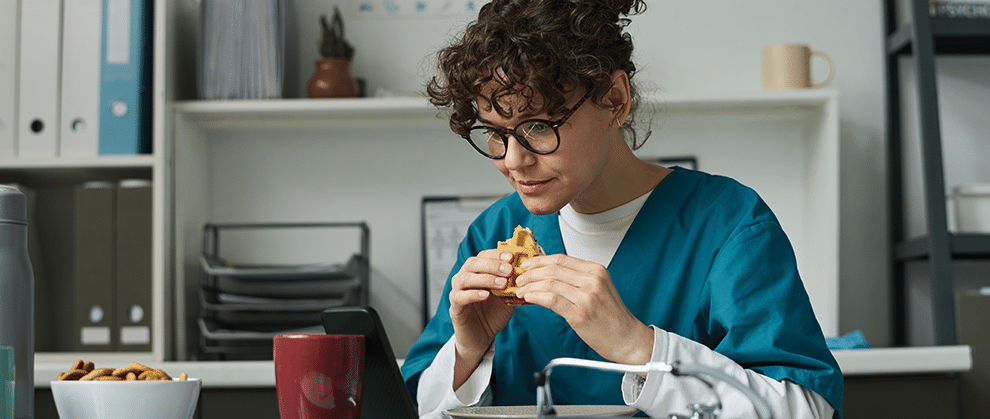
It’s 2:10 pm in a general practice and the day has already been a full-contact sport. A routine appointment spills over. The “simple” follow-up turns into a deeper conversation. A client’s frustration rises. A radiograph needs a second opinion—now. Your veterinary nurse is waiting on guidance so they can move the case forward. You’re bouncing from room to room, then back to the computer, shifting constantly between clinical judgment, client communication, and workflow decisions with no real break.
And then it hits: You’re rereading the same line in the medical record. Your patience is thinner than it was at 9 am. Small decisions feel oddly heavy. You realize you’ve had coffee … and whatever was in the break room—often cookies and baked goods dropped off by grateful clients—because it was there and it was fast.
If this feels familiar, the problem usually isn’t “nutrition knowledge.” It’s that clinic life creates fuel volatility: long gaps between meals, highly processed convenience foods, and stress-driven eating habits that can leave you feeling foggy right when you need to think clearly.
This article isn’t about eating perfectly. It’s about building a simple, repeatable clinic-day fuel system that protects 3 things that matter in the veterinary practice: steady energy, clearer thinking, and stress resilience.
The Blood Sugar Dip That Feels Like Brain Fog
Most clinicians don’t experience a single dramatic crash. They experience a predictable pattern: a quick hit of energy from refined carbs (or sugary snacks), followed by a dip that feels like sluggish thinking, irritability, and “why am I hungry again already?” This pattern is especially common when the go-to options are ultraprocessed foods (UPFs)—many of the grab-and-go snacks in break rooms are built around refined starches and added sugars, which can push the spike-then-dip cycle.
In nutrition research, this is often discussed as the difference between higher–glycemic impact meals (which can spike and drop faster) and lower–glycemic impact meals (which tend to provide a steadier release of energy). Research suggests that lower–glycemic impact meals are often linked to better postmeal cognitive performance, specifically attention and memory; however, findings differ based on the population and study methods.1
You don’t need to micromanage glycemic index at work. You just need to reduce the extremes—because when your brain feels foggy, clinical decision-making and communication can get harder.
Ultraprocessed Foods: What We’re Actually Talking About
Foods are sometimes grouped by how much industrial processing they’ve undergone using a framework called the NOVA classification. In NOVA’s highest-processing category, UPFs are industrial formulations made largely from refined or extracted ingredients, often combined with additives (like flavors and emulsifiers) to create products that are convenient, shelf-stable, and highly palatable.2
Importantly, this isn’t a morality label—UPFs often dominate clinic break rooms because they’re portable, they’re shareable, and they show up as gifts (BOX 1). The goal is not to shame the cookie tray. The goal is to stop letting it become your default fuel source.
- Cookies, brownies, pastries, donuts,
snack cakes - Candy bowls (e.g., chocolates, gummies)
- Chips, cheese puffs, flavored crackers
- Sugary drinks and many energy drinks
The Clinic-Day Fuel System: 3 Levers That Work in Real Life
Here’s the system I recommend to busy clinicians because it’s simple and repeatable, and it doesn’t require “perfect nutrition:”
- Anchor meal (insurance against chaos)
- Microfueling (protein and fiber, every 3 to 4 hours)
- UPF swaps (keep convenience, upgrade the outcome)
Lever 1: The Anchor Meal
On clinic days, an “anchor meal” is the meal that prevents you from being break room–dependent by late morning or early afternoon. Think of it as your insurance policy. It doesn’t have to be fancy. It does have to be reliable.
A practical template is protein, a fiber-containing carb, and some fat. Why protein? Because protein generally increases satiety more than carbohydrate or fat and can help you feel “held” longer—exactly what you want when your next true break is unpredictable.3
Anchor meal examples that may fit a normal clinic morning (especially when you have fridge/microwave access):
- Greek yogurt plus berries and nuts (or chia seeds)
- Eggs plus fruit and whole-grain toast
- Leftovers in a container: burrito bowl with rice, protein, and veggies
If you’re not hungry early in the day, don’t overthink it. “Something” is still protective. Think a yogurt drink and half a banana before you walk in the door. The goal is to start the day with a steady base so your first true fueling decision isn’t made while you’re stressed, hungry, and staring at a tray of cookies.
Lever 2: Microfueling, the 2-Minute Snack Strategy
Most clinicians don’t struggle because they didn’t pack a perfect lunch. They struggle because the schedule breaks their plan. Microfueling is how you stay functional when your “lunch break” becomes 2 minutes between exam rooms.
The simplest rule I use with high-performing professionals is pair protein with fiber. It’s the easiest way to reduce fuel volatility without tracking anything. Research in controlled settings finds that higher-protein preloads increase fullness more than lower-protein options, making protein-forward snacks especially useful during long work blocks.4 Fiber is the other half of the equation because it slows digestion and can blunt the glycemic response of a meal or snack—helpful when you’re trying to avoid the spike-then-dip pattern.5
Here’s a snack ladder built for clinic logistics:
- No-fridge options: tuna/salmon packets, roasted edamame or chickpeas, nuts and a piece of fruit, lower-sugar jerky/meat sticks
- Fridge options: cottage cheese, hard-boiled eggs, Greek yogurt (go for plain and top with berries to avoid added sugar), hummus and veggies
- 60-second assembly options: deli turkey and apple slices, leftovers you can eat cold or microwave quickly
If you implement only a single change this week, make it this: Bring a dependable protein option to work every day. Think of it as PPE for your brain.
Lever 3: UPF Swaps
In real clinics, the cookie tray isn’t going away—and it doesn’t need to. The practical win is changing the order so you can keep the convenience while upgrading the outcome: protein and fiber first, cookie second (if you still want it).
This single shift often changes everything. When you eat a quick refined-carb snack on an empty tank, the energy bump tends to be short-lived, and you’re back hunting for food again. When you microfuel first, you’re less likely to end up in the “snack spiral,” and you’re more likely to choose intentionally instead of reactively.
A few clinic-realistic swaps:
- If your break room has cookies and pastries, keep a “default” snack you eat first.
- If chips are the go-to, pair them with protein (or shift to a simpler-ingredient option and keep protein as the anchor).
- If you’re living on sweetened coffee drinks, treat them like dessert and pair them with real food—don’t let them replace meals.
This approach matches what we know about UPFs: They’re designed to be easy to eat, easy to overeat, and easy to rely on when time is short and stress is high.2
Make It a Team Sport: “Clinic Fuel Culture” Without Adding Workload
A clinic doesn’t need a wellness program to improve nutrition defaults. It needs a few small systems that make the better choice the easy choice. Create a “protein bin” in the fridge with yogurt, eggs, and cottage cheese. Add a small shelf-stable protein drawer stocked with tuna packets, nuts, and roasted chickpeas. Keep the cookie gifts (culture matters) but add structure so there’s a treat plate and quality fuel options. Get the best of both worlds.
If leaders want a simple justification: You’re not buying snacks, you’re protecting staff energy and attention during high-cognitive-demand work. Research on healthcare workers shows meal skipping and nonoptimal snacking patterns are common in shift settings, which is exactly when default options matter most.6
The 5-Day Clinic Fuel Challenge
If you want this to work, don’t overhaul everything. Pick a single lever to follow for 5 clinic days:
- Anchor meal before work (or early in shift) every day
- Microfuel once per shift with protein and fiber
- Make a UPF swap your new default (protein first before break room baked goods)
At the end of the week, ask yourself the question: Did my energy and focus feel more stable in the second half of the day? If yes, you’ve found a system worth keeping. Because in general practice, your day will stay unpredictable. Your fueling system doesn’t have to be.
References
- Philippou E, Constantinou M. The influence of glycemic index on cognitive functioning: a systematic review of the evidence. Adv Nutr. 2014;5(2):119-130. doi:10.3945/an.113.004960
- Monteiro CA, Cannon G, Levy RB, et al. Ultra-processed foods: what they are and how to identify them. Public Health Nutr. 2019;22(5):936-941. doi:10.1017/S1368980018003762
- Paddon-Jones D, Westman E, Mattes RD, Wolfe RR, Astrup A, Westerterp-Plantenga M. Protein, weight management, and satiety. Am J Clin Nutr. 2008;87(5):1558s-1561s. doi:10.1093/ajcn/87.5.1558S
- Dhillon J, Craig BA, Leidy HJ, et al. The effects of increased protein intake on fullness: a meta-analysis and its limitations. J Acad Nutr Diet. 2016;116(6):968-983. doi:10.1016/j.jand.2016.01.003
- Frampton J, Murphy KG, Frost G, Chambers ES. The impact of glycaemic load on cognitive performance: a meta-analysis. Neurosci Biobehavl Rev. 2022;141:104824. doi:10.1016/j.neubiorev.2022.104824
- McCurley JL, Levy DE, Dashti HS, et al. Association of employees’ meal skipping patterns with workplace food purchases, dietary quality, and cardiometabolic risk: a secondary analysis from the ChooseWell 365 trial. J Acad Nutr Diet. 2022;122(1):110-120.e2. doi:10.1016/j.jand.2021.08.109