
To take the CE quiz, click here.
This quiz is open until October 2028.
Pain is one of the most common yet complex problems that veterinarians face when caring for horses, and it significantly affects patient welfare. Pain management can be challenging because pain can be caused through multiple pain pathways from numerous sources. A key component in pain management is understanding the differences between acute and chronic pain as well as accurately assessing pain. By accurately assessing pain, equine veterinarians are more able to determine the efficacy of their pain management plan. To help equine practitioners assess pain, equine pain scoring systems and gait (lameness) evaluation methods have been developed. Treatment options include mainstays such as NSAIDs as well as opioids or drugs targeting central sensitization. Multimodal pain management with drugs can be very helpful, especially in horses with severe or chronic pain. Multimodal pain management addresses different parts of the pain pathway, instead of a single part, by using multiple medications with differing mechanisms of action at the same time. Advancements in developing new methods of administration or dosing regimens for these drugs have improved veterinarians’ ability to effectively manage equine patient pain.
Take-Home Points
- Accurately assessing a horse’s pain, especially horses with severe pain responses, such as allodynia or hyperalgesia, helps the practitioner create an effective pain management plan.
- The first line of equine pain management is still NSAIDs; however, acetaminophen and transdermal flunixin meglumine have recently been added as options.
- Drugs that treat central sensitization can effectively manage neuropathic pain; pregabalin has recently been evaluated for equine pain management.
- Opioids may be less likely to cause gastrointestinal stasis than previously thought; new oral and transdermal administration formulations are now available for use in horses.
Pain management is a critical component of ensuring equid welfare and reducing patient morbidity.1-3 Pain management involves assessing a horse’s pain and using pain-modifying drugs or therapies. Pain assessment is a critical part of pain management because it helps a veterinarian determine which therapies to use and their effectiveness. Veterinarians rely on their ability to observe equine gait, behavior, pain scoring, and communication with the horse’s caretaker to determine a horse’s magnitude of pain.1-7 However, assessments can be confounded by the patient’s pain tolerance and the veterinarian’s choice of pain scoring system (PSS) among the multitudes available.1-7 Despite these limitations, veterinarians caring for equine patients continue to do their best to assess their patients’ pain and manage it as adequately as possible.
Types of Pain
Acute
Acute pain is a response to injury or a painful event that activates the sensory nerve receptors of the peripheral nervous system, called nociceptors.2 Activated nociceptors then send signals to the spinal cord via the dorsal horn, which transmits the signals to the brain, which then perceives and responds to the pain.2 This response is a survival mechanism and benefits the animal by leading to avoidance of the painful event.1,2 However, the brain also signals the release of hormones and body system responses that can have deleterious effects, such as decreased wound healing or gastrointestinal stasis.1,2
When a patient’s pain is persistent, the pain pathways can become sensitized in either the peripheral (peripheral sensitization) or central (central sensitization) nervous system.2
- Peripheral sensitization is persistent pain at nociceptors at a site of injury/pathology, which lowers nociceptor pain thresholds and results from inflammation.2 Lowering of nociceptor thresholds leads patients to react to lower levels of stimuli and also can engender central sensitization.2
- Central sensitization is upregulation of pain signaling between central nervous system (CNS) neurons, causing an excessive response to a painful stimulus instead of an expected response.2
The excessive response to a painful stimulus is called hyperalgesia and is linked to the nervous system’s N-methyl-ᴅ-aspartate (NMDA) receptors and glutamate neurotransmission.2 In addition, an aggressive or hyperreactive response to what is typically considered a nonpainful stimuli (e.g., gently brushing hair) may develop and is referred to as allodynia (VIDEO 1).2 Central sensitization is much more challenging to manage than other forms of pain and often leads to chronic pain.2
Chronic
Chronic pain is a complex process; it often continues after the injury has healed or the event has passed, is challenging to manage, and has no beneficial effects for the patient.2 Whenever possible, preventing pain through administration of analgesics or local anesthetics before a procedure or known painful event (i.e., preemptive analgesia) is the best way to mitigate chronic pain.2 However, when pain mitigation is not possible, a multimodal pain management plan (e.g., analgesics, physiotherapy, and supportive care) is recommended to reduce chronic pain and provide comfort for the patient.2
Patient Assessment
Before pain can be effectively managed, it first must be identified, which can be challenging for either acute or chronic pain. Heart rate and respiratory rate are physiologic parameters that can indicate pain but are inconsistent because they also fluctuate for other pathologic or physiologic reasons.2 Multiple methods are used to assess and score a horse’s pain.
Gait
When evaluating horses for pain by using gait assessment, note that gait may be affected by musculoskeletal pain (lameness), neurologic deficits (ataxia), or mechanical factors (e.g., fibrotic myopathy, stringhalt). This article focuses on gait asymmetry associated with musculoskeletal pain.
Practitioners evaluating equids for lameness should know what is considered a normal gait for the breed and discipline of the horse that is being evaluated. For example, the trot of a Hackney pony looks different than that of an Appaloosa. Typically, an equid is evaluated at the walk (VIDEO 2) and trot (VIDEO 3) and sometimes at the canter/lope or ridden under saddle/tack.4-7 Horses are evaluated in straight lines, in circles (both directions), and/or during the specific activity that demonstrates the lameness (e.g., during collection, lead changes).4-7 During lameness examinations, the horse’s head, shoulder, hip excursion, limb flight/arc, limb posture, and ability to bear weight are all subjectively assessed and then scored according to previously reported lameness scales.4-7
Multiple lameness scales have been developed, and practitioners should determine which are the most consistent and effective, as different scales may score pain at varying levels.4-7 Subjective grading of lameness is a fundamental principle of lameness evaluation; however, objective equine lameness evaluation tools have also been developed.6 Objective evaluations typically involve measurements using gait kinematics, force vectors, or a wireless inertial sensor-based system (WISMA).6 The WISMA tool seems to be more feasible for use in a clinical setting and has been validated for evaluation of equine lameness.6
Whether the evaluation is subjective or objective, after an initial lameness examination, a horse often receives locoregional anesthesia (i.e., nerve/joint blocks) to determine the location causing the lameness (VIDEO 4).4-8 Localization is key for diagnosing the cause of pain and determining whether a pain management plan is as effective as the locoregional block.
Behavior/Activity Assessment
Determining if pain may be affecting or causing abnormal behaviors or activity requires knowing and understanding normal horse behaviors.1-3 Horses may display signs of generalized pain such as decreased activity, reduced appetite, aggressive/antisocial behavior, or lethargy.1,2,9,10 In addition, a horse with abdominal pain may exhibit specific pain behaviors such as flank watching or rolling, and a horse with musculoskeletal pain may exhibit lameness.1,2,9,10
Multiple composite behavioral pain scales have been developed and reported for musculoskeletal, visceral, or laminitic pain in horses.1,2,9-13 Although there is no universal PSS for horses, and creating one is likely impossible given the multiple types of pain, use of a PSS can help standardize how veterinarians assess a horse’s level of pain and response to treatment.1,2,9-13 Choose a PSS that is feasible and applicable to the horse’s condition. For example, a PSS designed for postoperative colic surgery cases may be less helpful for assessing a laminitis case. It is also helpful to determine if the PSS is used for acute or chronic pain. For example, a PSS for acute pain or inflammation is based on horses’ grimace or facial expression (e.g., ear position, eye position, tension around the eye, nostril size, tension of the facial muscles).11-13 A PSS should describe or show (i.e., images, videos) specific behaviors, body part position, and/or actions, which a veterinarian observes and correlates with a PSS number.1,2,9-13 Totaling the PSS numbers gives a relatively objective way to evaluate the horse’s pain; higher numbers typically indicate greater pain levels.1,2,9-13 After treatment, the new PSS total can be compared with the total score before treatment.1,2,9-13
A composite equine behavioral pain scale using previously reported pain scales has also been developed.1 This equine pain scale assigns a pain score number regarding the patient’s facial expression, generalized pain behavior (e.g., excessive head movement, kicking, rolling, flank watching), position in the stall, posture/weight-bearing, head position, interactive behavior, response to food, and attentiveness to a painful area (e.g., flank watching).1
Although choosing among individual or composite PSSs can be challenging, they are fundamentally critical when evaluating the efficacy of pain management in horses. PSSs enable veterinarians to objectively manage their patients’ pain rather than rely on their own subjective evaluation.
Pain Management Therapies
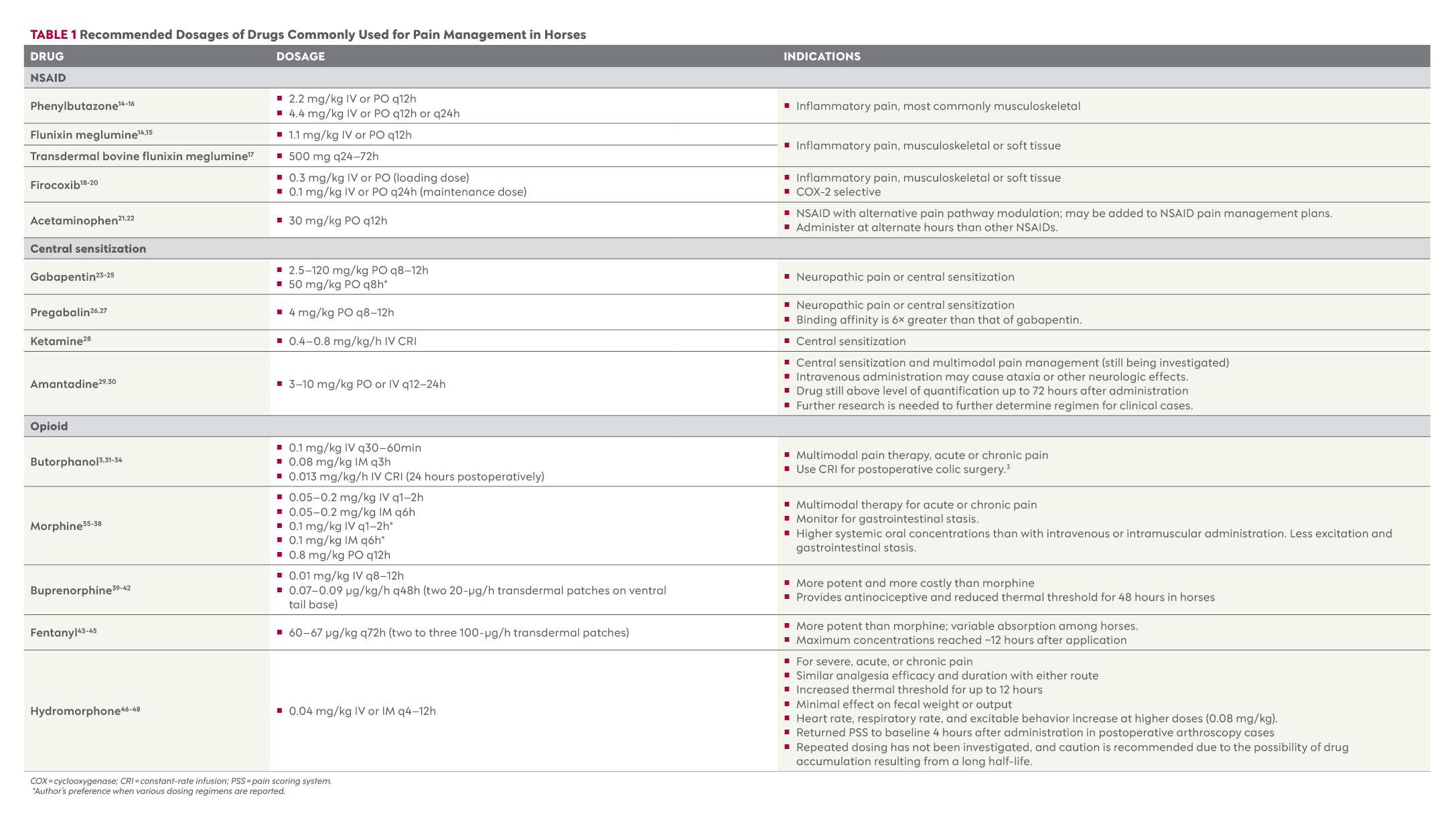
The drugs most commonly used for management of equine pain are NSAIDs, central sensitization drugs, and opioids. Dosing regimens are shown in TABLE 1.
NSAIDs
NSAIDs are frequently the first line in analgesic drug therapy due to their effectiveness, affordability, and availability.2,14,15 Their mechanism of action is inhibition of cyclooxygenase (COX) enzymes that produce prostaglandins, which are associated with normal physiologic function, inflammation, pain signaling, and vascular changes in blood flow.2,14,15 The COX-1 enzyme is more associated with normal physiologic processes (e.g., kidney, gastrointestinal tract), whereas the COX-2 enzyme is more associated with inflammation, although it still has physiologic homeostatic properties.2,14,15 A COX-3 enzyme has been reported, but its role in horses is not as well understood.14,15
Different types of NSAIDs are available for equine patients, including nonselective NSAIDs (NSAIDs that inhibit both COX-1 and COX-2) and COX-2–selective NSAIDs.14,15 Theoretically, COX-2–selective NSAIDs pose less risk for the patient than nonselective NSAIDs; however, COX-2 NSAIDs still contribute to normal physiologic processes and COX-2 inhibition can still lead to adverse effects.14-22
Phenylbutazone
Phenylbutazone is a nonselective NSAID that is commonly prescribed for the treatment of inflammation and pain in equine patients.2,14-16 Phenylbutazone is typically dosed at 2.2 to 4.4 mg/kg q12h to q24h either intravenously or orally.14-16 Dosing at 4.4 mg/kg q12h warrants caution because the more frequent dosing increases the risk for adverse effects.14-16 In addition, doses higher than 4.4 mg/kg have demonstrated no increased analgesic efficacy when administered to horses.16 Recently, administration of phenylbutazone via intravenous regional limb perfusion (IVRLP) in the cephalic veins of horses was evaluated to determine if radiocarpal joint synovial fluid concentrations were significantly higher than systemic phenylbutazone concentrations.17 In that study, however, systemic concentrations were still higher than synovial concentrations, showing that there may not be a benefit to phenylbutazone IVRLP.49
Flunixin Meglumine
A nonselective NSAID, flunixin meglumine is effective for reducing inflammation and pain in horses.14,15 The dose for flunixin meglumine is 1.1 mg/kg IV or PO q12h to q24h using the injectable formulation.14,15 Recently, the transdermal formulation for cattle was evaluated for use in horses by administering a single 500-mg transdermal dose,17 which showed COX inhibition for 24 to 72 hours after administration with no observed adverse effects.17 However, the maximum flunixin meglumine concentration was lower and took longer to reach than that reported for other routes of administration.17 The transdermal formulation for cattle could, however, be an option for horses for which injection or oral administration is not feasible.
Firocoxib
This COX-2–selective NSAID can be administered orally as a paste or tablet.2,14,15 An initial loading dose of 0.3 mg/kg followed by 0.1 mg/kg q24h will provide analgesic concentrations on the first day; otherwise, a 0.1 mg/kg q24h dose takes 5 to 7 days to reach analgesic concentrations.18-20 In 1 study, the analgesic efficacy of firocoxib in horses with chronic osteoarthritis was found to be similar to that of phenylbutazone.20 Because of its COX-2 selectivity, firocoxib may be beneficial for patients in which the NSAID adverse effects are more concerning.18-20 Anecdotally, future studies of firocoxib may evaluate the washout period after prolonged firocoxib administration because it may take longer for the equine body to clear than phenylbutazone or flunixin meglumine.
Acetaminophen
Although technically an NSAID-class drug due to slight COX inhibition, acetaminophen (paracetamol) provides analgesia through alternative pathways compared with other NSAIDs.21 The alternative pathways are why acetaminophen poses less risk than other NSAIDs for gastrointestinal or renal injury,21 which can be appealing for patients for which gastrointestinal (e.g., colitis) or renal injury is a concern; however, the anti-inflammatory and analgesic effects of acetaminophen may be less than those of other NSAIDs.21,22
The dose for acetaminophen is 30 mg/kg PO q12h and has been shown to reduce lameness in horses with naturally occurring chronic lameness.22 In 1 study, 12 horses were given that dose for 21 consecutive days, with no changes in liver biopsy scores, CBC/chemistry, or gastroscopy scores.22 The dearth of adverse effects traditionally seen with NSAID use has led to acetaminophen being given in conjunction with other NSAIDs to humans and horses.21,22 Acetaminophen use is appealing because it can help manage pain when NSAID use alone is not enough. Anecdotally, when NSAIDs and acetaminophen are used together, they are not given at the same time. For example, a horse receiving phenylbutazone at 8 am might receive acetaminophen at 10 am. However, there is no study in horses recommending the dosing regimen for NSAIDs and acetaminophen.
Central Sensitization Drugs
Drugs of this class are used for other conditions such as seizures or heart arrhythmias; however, they have also shown analgesic effects, although not well understood, that can be used to manage equine pain.2
Gabapentin
Traditionally used as an antiseizure medication, gabapentin has also been used to treat neuropathic pain in humans and horses.2,23-25 The precise mechanism of action for gabapentin’s analgesic effect is undetermined, but it does seem to be associated with binding calcium voltage-gated subunits within the nervous system.2,23-25 The neuropathic effect of pain management gives gabapentin an alternative pathway, compared with NSAIDs, to provide analgesia in horses.2,23-25
The dosing range of gabapentin in horses is quite wide, ranging from 2.5 to 120 mg/kg PO, typically q8h to q12h.2,23-25 Anecdotally, it seems that a range of 20 to 50 mg/kg PO q8h to q12h may be more commonly used in clinical practice. Gabapentin is also well tolerated in the horse and can be used in combination with NSAIDs or other pain management therapies without increased risk for adverse effects.2,23-25 Although gabapentin has been reported to be effective for managing neuropathic pain,25 anecdotally there are uncertainties regarding its efficacy in horses. Two studies also show that gabapentin was not effective for reducing lameness scores in chronically lame horses.24,25 In 1 study, horses were administered gabapentin, firocoxib, or both, and gabapentin alone led to no decreased lameness compared with the control group.23 Gabapentin can be used as part of an equine pain management plan, but further studies are warranted.
Pregabalin
Used originally as an antiseizure medication, pregabalin has also been used to treat neuropathic pain in horses.26,27 The mechanism for pregabalin is unknown, but it seems to work on calcium voltage-gated channels within the nervous system, similar to gabapentin.23-27 The oral bioavailability of pregabalin is better than the 16% of gabapentin, and its binding affinity for the calcium channel subunits is 6 times greater than that of gabapentin,25-27 which may enable pregabalin to provide more pain management than gabapentin. However, no studies of analgesic effect, nociceptive reduction, or direct comparison in horses have been conducted. A dosing regimen of pregabalin at 4 mg/kg PO q8h has been shown to provide steady-state concentrations at the therapeutic range reported in humans.27 Anecdotally, pregabalin dosing q12h may be effective when q8h administration is not feasible.
Ketamine
Frequently used to induce anesthesia in horses, ketamine has been used at subanesthetic doses for equine pain management.2,28,50-52 The mechanism of action is within the spinal cord as an NMDA receptor antagonist, which can effectively prevent and treat central sensitization in horses with significant pain, such as that of laminitis.2,28,50-52
Ketamine has a short duration of action (approximately 15 minutes) after intravenous administration and is likely more useful administered as a continuous rate infusion (CRI) than an IV bolus,2,28,50-52 which may be practical in a hospital or clinic setting but more challenging in a field setting. Subcutaneous and intramuscular administration has also been investigated in horses; however, analgesic concentrations of the investigated doses were not reached.50 No adverse effects of 0.4- and 0.8-mg/kg/h doses with an IV CRI were observed; however, an analgesic effect could not be identified in that study.50 In addition, a prolonged ketamine CRI has been shown to decrease gastrointestinal transit time in horses, although other physiologic parameters were not affected.52 Ketamine may be a useful analgesic in cases of central sensitization, although care should be taken when administering ketamine as a CRI, and its efficacy with pain scoring should be evaluated.
Amantadine
Pharmacokinetics and pharmacodynamics of an antiviral drug that is also an NMDA receptor antagonist drug have been investigated in horses.29,30 The intravenous and oral routes of administration of amantadine have been evaluated at a range of doses (5 to 20 mg/kg).29,30 Intravenous administration at 5 mg/kg has been shown to reduce the number of steps a horse takes compared with baseline preadministration values.30 However, after intravenous administration, horses have displayed temporary neurologic effects (e.g., seizure-like activity) at 20 mg/kg or ataxia at 5 mg/kg.29,30 In 2 of 8 horses, oral administration seemed more well tolerated than IV dosing; only mild sedative effects were noted 1 hour after administration at 3- and 5-mg/kg doses.30 When compared with baseline values, oral amantadine administration led to fewer steps taken by horses and lower heart rates for up to 8 hours.30 Gastrointestinal borborygmi scores have been shown to increase after amantadine administration at doses of 3 to 5 mg/kg for up to 24 hours but did not significantly differ at 10 mg/kg PO.30 Amantadine may provide another option for multimodal pain therapy; however, its use has been investigated in only 2 studies. Further investigation using pain models or clinical studies will be useful.
Opioids
The analgesic effects of opioids result from their partial or complete binding to µ or κ receptors within the CNS and in the peripheral nervous system at sites of inflammation.2,31 However, there is concern about the brief analgesic effects of opioids and adverse effects in horses, which include excitation and/or reduced gastrointestinal motility,2,31 although these effects are not always shown throughout studies.2,32-38 In addition, opioids given to nonpainful horses may produce more excitement.2,31-37 Feasibility of using opioids in nonhospitalization/clinic settings may be limited by their classification as a controlled, regulated substance.
Butorphanol
Butorphanol is unique and differs from µ agonist opioids commonly given to horses because it is a κ agonist and µ antagonist.2,3,31-37 Similar to other opioids, butorphanol may still cause excitation in some patients, but gastrointestinal motility effects are less.2,3,31-34 The analgesic dose of a butorphanol IV bolus is 0.1 mg/kg and an IM bolus is 0.08 mg/kg.2,3,31-34 Duration of butorphanol administered as a bolus is relatively short, 30 to 60 minutes when given intravenously, and up to 3 hours when given intramuscularly, with minimal analgesic effects.2,3,31-34 The analgesic effects are so minimal that the analgesic dose is typically higher than that used for sedation.2,3,31-34 Because of its short duration of action, use of butorphanol as a CRI in horses has been investigated.2,3 A butorphanol CRI at 0.013 mg/kg/h given for 24 hours after exploratory celiotomy resulted in lower pain scores and plasma cortisol levels than those of control horses.3
Morphine
Morphine is a full µ agonist, and its analgesic effects have been investigated in horses. It has been associated with decreased gastrointestinal motility2,31,35-40; however, the changes to motility have been shown in some studies but not in others.35-47 The dose of morphine is 0.05 to 0.2 mg/kg IV or IM; the duration after intramuscular administration is up to 6 hours.2,31,35-37 Anecdotally, a dose of 0.1 mg/kg IV or IM seems to be useful in clinical practice. Although morphine may be used for pain management, horses should be carefully monitored for adverse effects and further investigation is warranted.
More recently, oral administration of morphine in horses has been evaluated.38 Oral doses of morphine at 0.8 mg/kg q12h for 4.5 days produced greater morphine concentrations and similar antinociceptive effects compared with a 0.2-mg/kg IV dose.38 Horses in the study that received morphine orally also showed less excitation and less reduction in gastrointestinal motility than did horses that received it intravenously.38 Oral administration was performed by using 10-mg morphine sulfate tablets dissolved in a syringe,38 which may be a more feasible method for q12h administration than injectable methods of morphine administration.
Buprenorphine
A µ agonist and κ antagonist, buprenorphine has been evaluated in horses at 0.01 mg/kg IV q8h to q12h, which has provided antinociceptive and analgesic effects.2,39-41 It has been evaluated in ponies undergoing castration and in horses that underwent elective surgical procedures.2,39-41 For the horses after elective surgery, buprenorphine provided more adequate analgesia than butorphanol given to similar patients.40 Buprenorphine administration has led to excitation, colic, and muscle twitching; however, these adverse effects do not seem to be consistent among studies39-41 and may be more likely to occur in nonpainful than in painful horses.2,39-41
The longer duration of buprenorphine compared with morphine makes it appealing for pain management in horses; however, its expense may be a limiting factor. Recently, a transdermal method of buprenorphine administration has been evaluated in horses and may be relatively less financially prohibitive than injectable administration.42 In that study, buprenorphine transdermal patches at a 0.07- to 0.09-µg/kg/h dose, or two 20-µg/h patches, were applied to the ventral aspect of the tail base of adult horses.42 Thermal thresholds were higher in horses for up to 48 hours; no physiologic differences from baseline were noted when compared with lower dosing or controls.42 Thermal thresholds became higher than those of controls 2 hours after application of the buprenorphine patches.42
Fentanyl
A synthetic µ agonist, fentanyl is more potent than traditional µ agonists and has a rapid onset of action.2,31,43-45 It also has a shorter duration of action, which can be beneficial because its adverse effects would not last long.2,31,43-46 However, the short duration of action also means that an intravenous CRI of fentanyl would be needed for pain management.2,31,43-45
Transdermal fentanyl patches, which provide a prolonged release of fentanyl for up to 72 hours, have been investigated for pain management in horses.2,31,43-45 The dose for transdermal fentanyl patches in adult horses is typically application of 2 to 6 patches, 100 µg/h each, most frequently only 2 to 3 patches (60 to 67 µg/kg).2,31,43-45 The time to reach maximum concentrations after application is typically about 12 hours.44 Application sites include the dorsal metacarpal region, tail head, cephalic region of the forelimb, mid-dorsal thoracic region, and inguinal region, with hair clipped or shaved if necessary.2,31,43-45 The sites are then aseptically prepared and allowed to dry before the patch is placed, after which the patch is typically secured in place with an elastic adhesive tape. Although absorption of transdermal fentanyl can be good, individual variations of plasma levels and location of absorption have been reported.43-45 In addition, there are reports of effective analgesia as well as reports of little analgesic effect and lack of antinociceptive activity.2,42-45 Each patient should be monitored to determine whether the patches seem to be effective.
Hydromorphone
Hydromorphone is a µ agonist that has recently been evaluated after intravenous or intramuscular administration to horses.46-48 Hydromorphone has shown increased thermal threshold activity in horses when administered at 0.04 or 0.08 mg/kg IV.46-48 However, the 0.08-mg/kg dose led to more behavioral excitation, increased heart rate, and increased respiratory rate than the lower 0.04-mg/kg dose.46-48
The pharmacokinetics for hydromorphone were also similar whether it was administered to horses intravenously or intramuscularly.47 The duration of action is 4 to 12 hours with increased thermal thresholds up to 12 hours but started to decline after 5 hours.46-48
Hydromorphone has also been shown to lower PSS values after arthroscopic surgery more than after butorphanol administration; PSS returned to baseline 4 hours after hydromorphone administration.48 There is some concern for drug accumulation after repeated dosing; however, repeated dosing has not yet been investigated.46-48
Summary
Pain management in horses is a complex process that can be associated with multiple steps in the pain pathway. Assessing a horse’s pain is a critical component for developing a pain management plan and determining its effectiveness. Pain management options available to veterinarians caring for equine patients include NSAIDs, central sensitization drugs, and opioids. Understanding the options available, their efficacy, and how they can be used in multimodal pain management is crucial for successfully managing pain in the horse.
References
- Gleerup KB, Lindegaard C. Recognition and quantification of pain in horses: a tutorial review. Equine Vet Educ. 2016;28(1):47-57. https://doi.org/10.1111/eve.12383
- Love EJ. Equine pain management. In: Auer JA, Stick JA, Kummerle JM, Prange T, eds. Equine Surgery. 5th ed. Elsevier; 2019:356-366.
- Sellon DC, Roberts MC, Blikslager AT, Ulibarri C, Papich MG. Effects of continuous rate intravenous infusion of butorphanol on physiologic and outcome variables in horses after celiotomy. J Vet Intern Med. 2004;18(4):555-563. doi:10.1892/0891-6640(2004)18<555:eocrii>2.0.co;2
- Dyson S. Can lameness be graded reliably? Equine Vet J. 2011;4(4):379-382. doi:10.1111/j.2042-3306.2011.00391.x
- Veterinarian’s guide to equestrian competition official duties. American Association of Equine Practitioners. 2020. Accessed July 17, 2020. https://aaep.org/wp-content/uploads/2024/01/AAEPCompetitionGuidelinesforVeterinarians2020.pdf
- Keegan KG, Kramer J, Yonezawa Y, et al. Assessment of repeatability of a wireless, inertial sensor-based lameness evaluation system for horses. Am J Vet Res. 2011;72(9):1156-1163. doi:10.2460/ajvr.72.9.1156
- Ross M. Movement. In: Ross M, Dyson S, eds. Diagnosis and management of Lameness in the Horse. 3rd ed. Elsevier; 2010:64-79.
- Moyer W, Schumacher J. A Guide to Equine Joint Injection and Regional Anesthesia. Veterinary Learning Systems; 2007.
- Price J, Catriona S, Welsh EM, Waran NK. Preliminary evaluation of a behaviour-based system for assessment of postoperative pain in horses following arthroscopic surgery. Vet Anaesth Analg. 2003;30(3):124-137. doi:10.1046/j.1467-2995.2003.00139.x
- Pritchett LC, Ulibarri C, Roberts MC, Schneider RK, Sellon D. Identification of potential physiological and behavioral indicators of postoperative pain in horses after exploratory celiotomy for colic. Appl Anim Behav Sci. 2003;80(1):31-43. https://doi.org/10.1016/S0168-1591(02)00205-8
- Dalla Costa E, Minero M, Lebelt D, Stucke D, Canali E, Leach MC. Development of the Horse Grimace Scale (HGS) as a pain assessment tool in horses undergoing routine castration. PLoS One. 2014;9(3):e92281. doi:10.1371/journal.pone.0092281
- Dalla Costa E, Stucke D, Dai F, Minero M, Leach MC, Lebelt D. Using the horse grimace scale (HGS) to assess pain associated with acute laminitis in horses (Equus caballus). Animals (Basel). 2016;6(8):47 doi:10.3390/ani6080047
- Gleerup KB, Forkman B, Lindegaard C, Andersen PH. An equine pain face. Vet Anaesth Analg. 2015;42(1):103-114. doi:10.1111/vaa.12212
- Jacobs CC, Schnabel LV, McIlwraith CW, Blikslager AT. Non-steroidal anti-inflammatory drugs in equine orthopaedics. Equine Vet J. 2022;54(4):636-648. doi:10.1111/evj.13561
- Flood J, Stewart AJ. Non-steroidal anti-inflammatory drugs and associated toxicities in horses. Animals (Basel). 2022;12(21):2939. doi:10.3390/ani12212939
- Hu HH, MacAllister CG, Payton ME, Erkert RS. Evaluation of the analgesic effects of phenylbutazone administered at a high or low dosage in horses with chronic lameness. JAVMA. 2005;226(3):414-417. doi:10.2460/javma.2005.226.414
- Knych HK, Arthur RM, Gretler SR, McKemie DS, Goldin S, Kass PH. Pharmacokinetics of transdermal flunixin meglumine and effects on biomarkers of inflammation in horses. J Vet Pharamcol Ther. 2021;44(5):745-753. doi:10.1111/jvp.12993
- Letendre LT, Tessman RK, McClure SR, Kvaternick VJ, Fischer JB, Hanson PD. Pharmacokinetics of firocoxib after administration of multiple consecutive daily doses to horses. Am J Vet Res. 2008;69(11):1399-405. doi:10.2460/ajvr.69.11.1399
- Cox S, Villarino N, Sommardahl C, et al. Disposition of firocoxib in equine plasma after an oral loading dose and multiple dose regimen. Vet J. 2013;198(2):382-385. doi:10.1016/j.tvjl.2013.07.035
- Doucet MY, Bertone AL, Hendrickson D, et al. Comparison of efficacy and safety of paste formulation of firocoxib and phenylbutazone in horses with naturally occurring osteoarthritis. JAVMA. 2008;232(1):91-97. doi:10.2460/javma.232.1.91
- Graham GG, Davies MJ, Day RO, Mohamudally A, Scott KF. The modern pharmacology of paracetamol: therapeutic actions, mechanism of action, metabolism, toxicity, and recent pharmacological findings. Inflammopharmacology. 2013;21(3):201-232. doi:10.1007/s10787-013-0172-x
- Mercer MA, Davis J, McKenzie HC, et al. Pharmacokinetics, clinical efficacy and safety of acetaminophen (paracetamol) in adult horses with naturally occurring chronic lameness. Equine Vet J. 2024;56(1):202-214. doi:10.1111/evj.13959
- Young JM, Schoonover MJ, Kembel SL, Taylor JD, Bauck AG, Gilliam LL. Efficacy of orally administered gabapentin in horses with chronic thoracic limb lameness. Vet Anaesth Analg. 2020;47(2):259-266. doi:10.1016/j.vaa.2019.11.003
- Gold JR, Grubb TL, Cox S, Malavasi L, Villarino NL. Pharmacokinetics and pharmacodynamics of repeat dosing of gabapentin in adult horses. J Vet Intern Med. 2022;36(2):792-797. doi:10.1111/jvim.16386
- Terry RL, McDonnell SM, Van Eps AW, et al. Pharmacokinetic profile and behavioral effects of gabapentin in the horse. J Vet Pharmacol Ther. 2010;33(5):485-494. doi:10.1111/j.1365-2885.2010.01161.x
- Gajraj NM. Pregabalin for pain management. Pain Pract. 2005;5(2):95-102. doi:10.1111/j.1533-2500.2005.05205.x
- Mullen KR, Schwark W, Divers TJ. Pharmacokinetics of single-dose intragastric and intravenous pregabalin administration in clinically normal horses. Am J Vet Res. 2013;74(7):1043-1048. doi:10.2460/ajvr.74.7.1043
- McCartney CJL, Sinha A, Katz J. A qualitative systematic review of the role of N-methyl-D-aspartate receptor antagonists in preventative analgesia. Anaesth Analg. 2004;98(5):1385-1400. doi:10.1213/01.ane.0000108501.57073.38
- Rees WA, Harkins JD, Woods WE, et al. Amantadine and equine influenza: pharmacology, pharmacokinetics and neurological effects in the horse. Equine Vet J. 1997;29(2):104-110. doi:10.1111/j.2042–3306.1997.tb01650.x
- Riley HL, Mama KR, Jacobs ME, McKemie DS, Kass PH, Knych HK. Assessment of pharmacokinetic parameters, oral bioavailability, and physiological effects of amantadine in horses. BMC Vet Res. 2026;22(1):498. doi:10.1186/s12917-026-05672-9
- Bennet RC, Steffey EP. Use of opioids for pain and anesthetic management in horses. Vet Clin North Am Equine Pract. 2002;18(1):47-60. doi:10.1016/s0749-0739(02)00011-1
- Love EJ, Taylor PM, Clark C, Whay HR, Murrell J. Analgesic effect of butorphanol in ponies following castration. Equine Vet J. 2009;41(6):552-556. doi:10.2746/042516409×391024
- Sellon DC, Monroe VL, Roberts MC, Papich MG. Pharmacokinetics and adverse effects of butorphanol administered by single intravenous injection or continuous intravenous infusion in horses. Am J Vet Res. 2001;62(2):183-189. doi:10.2460/ajvr.2001.62.183
- Sellon DC, Papich MG, Palmer L, Remund B. Pharmacokinetics of butorphanol in horses after intramuscular injection. J Vet Pharmacol Ther. 2008;32(1):62-65. doi:10.1111/j.1365-2885.2008.01004.x
- Andersen MS, Clark L, Dyson SJ, Newton JR. Risk factors for colic in horses after general anaesthesia for MRI or nonabdominal surgery: absence of evidence of effect from perianaesthetic morphine. Equine Vet J. 2006;38(4):368-374. doi:10.2746/042516406777749263
- Devine EP, KuKanich B, Beard WL. Pharmacokinetics of intramuscularly administered morphine in horses. JAVMA. 2013;243(1):105-112. doi:10.2460/javma.243.1.105
- Guzmán JFC, Gontijo AS, de Sousa Melgaco E, et al. Analgesic and gastrointestinal effects of morphine in equines. Animals (Basel). 2025;15(4):571. doi:10.3390/ani15040571
- Knych HK, Steinmetz SJ, Traynham ML, McKemie DS, Kass PH. Pharmacokinetics and thermal anti-nociceptive effects of oral morphine in horses. Front Vet Sci. 2024;11:1461648. doi:10.3389/fvets.2024.1461648
- Love EJ, Taylor PM, Whay HR, Murrell J. Postcastration analgesia in ponies using buprenorphine hydrochloride. Vet Rec. 2013;172(24):635. doi:10.1136/vr.101440
- Taylor PM, Hoare HR, De Vries A, et al. A multicentre, prospective, randomized, blinded clinical trial to compare some perioperative effects of buprenorphine or butorphanol premedication before equine elective general anesthesia and surgery. Equine Vet J. 2016;48(4):442-450. doi:10.1111/evj.12442
- Potter JJ, MacFarlane PD, Love EJ, Tremaine H, Taylor PM, Murrell JC. Preliminary investigation comparing a detomidine continuous rate infusion combined with either morphine or buprenorphine for standing sedation in horses. Vet Anaesth Analg. 2016;43(2):189-194. doi:10.1111/vaa.12316
- Paranjape VV, Knych HK, Berhaus LJ, et al. Evaluation of physical variables, thermal nociceptive threshold testing and pharmacokinetics during placement of transdermal buprenorphine matrix-type patch in healthy adult horses. Front Pain Res (Lausanne). 2024;5:1373555. doi:10.3389/fpain.2024.1373555
- Orsini JA, Moate PJ, Kuersten K, Soma LR, Boston RC. Pharmacokinetics of fentanyl delivered transdermally in healthy adult horses – variability among horses and its clinical implications. J Vet Pharmacol Ther. 2006;29(6):539-546. doi:10.1111/j.1365-2885.2006.00796.x
- Reed RA, Berghaus LJ, Reynolds RM, et al. The pharmacokinetics and pharmacodynamics of fentanyl administered via transdermal patch in horses. Front Pain Res (Lausanne). 2024;5:1373759. doi:10.3389/fpain.2024.1373759
- Mills PC, Cross SE. Regional differences in transdermal penetration of fentanyl through equine skin. Res Vet Sci. 2007;82(2):252-256. doi:10.1016/j.rvsc.2006.07.015
- Reed RA, Barletta M, Mitchell K, et al. The pharmacokinetics and pharmacodynamics of intravenous hydromorphone in horses. Vet Anaesth Analg. 2019;46(3):395-404. doi:10.1016/j.vaa.2018.11.001
- Reed RA, Knych HK, Barletta M, et al. Pharmacokinetics and pharmacodynamics of hydromorphone after intravenous and intramuscular administration in horses. Vet Anaesth Analg. 2020;47(2):210-218. doi:10.1016/j.vaa.2019.08.049
- Reed R, Trenholme N, Skrzypczak H, et al. Comparison of hydromorphone and butorphanol in equine patients undergoing elective arthroscopy: a randomized clinical trial. Vet Anaesth Analg. 2022;49(5):490-498. doi:10.1016/j.vaa.2022.05.006
- O’Brien M, Mochel JP, Kersh K, Wang C, Troy J. Phenylbutazone concentrations in synovial fluid following administration via intravenous regional limb perfusion in the forelimbs in six adult horses. Front Vet Sci. 2023;10:1236976. doi:10.3389/fvets.2023.1236976
- Fielding CL, Brumbaugh GW, Matthews NS, Peck KE, Roussel AJ. Pharmacokinetics and clinical effects of a subanesthetic continuous rate infusion of ketamine in awake horses. Am J Vet Res. 2006;67(9):1484-1490. doi:10.2460/ajvr.67.9.1484
- Rangel A, Sellon DC, Sanz MG, Pinnell E, Pietras ZM, Villarino NF. Pharmacokinetics and safety of a single subcutaneous or intramuscular dose of ketamine in healthy horses. J Vet Pharmacol Ther. 2026;49(2):141-149. doi:10.1111/jvp.70037
- Elfenbein JR, Robertson SA, Corser AA, Urion RJ, Sanchez LC. Systemic effects of a prolonged continuous infusion of ketamine in healthy horses. J Vet Intern Med. 2011;25(5):1134-1137. doi:10.1111/j.1939-1676.2011.0761.x
CE Quiz
This article has been submitted for RACE approval for 1 hour of continuing education credit and will be opened for enrollment upon approval. To receive credit, take the test at vetfolio.com. Free registration is required. Questions and answers online may differ from those below. Tests are valid for 2 years from the date of approval.
1. Allodynia is a profound pain response to non-noxious (nonpainful) stimulation.
a. True
b. False
2. Which of the following is a way to effectively and consistently identify a horse’s pain and the response to pain management in that horse?
a. Radiography
b. Ultrasonography
c. Heart rate
d. Pain scoring according to a horse grimace scale
3. Which of the following NSAIDs provides alternative pain management instead of cyclooxygenase pathway inhibition?
a. Phenylbutazone
b. Acetaminophen
c. Firocoxib
d. Flunixin meglumine
4. Pregabalin has greater binding potential to calcium voltage-gated channels within the equine nervous system and greater than 16% bioavailability in horses.
a. True
b. False
5. Which of the following has shown antinociceptive and increased thermal threshold limits for up to 48 hours when applied transdermally to the ventral tail base of horses?
a. Morphine
b. Butorphanol
c. Buprenorphine
d. Ketamine