

Expert- and evidence-based guidelines in Canada and the United States advise annual screening for tick-borne pathogen exposure, particularly Anaplasma and Ehrlichia species, in adult dogs.1-3 This practice also serves to inform human disease risk, as dogs serve as sentinels for risk of infection associated with tick vectors present in the shared environment. Veterinary teams may feel unsure about next-step clinical management of healthy seropositive dogs, particularly when antibody is detected, since there is no current actionable consensus guideline (BOX 1).4
Clinical and CBC monitoring can be used along with PCR testing to differentiate acute, chronic, and resolved infection. In the acute phase of infection, when dogs are usually clinically ill, serology is often negative. A PCR test and CBC with blood film evaluation (with consideration of clinical pathologist review) to assess for infection (e.g., thrombocytopenia, morula) should be performed to detect early, active infection. Rapid resolution of clinical signs with doxycycline (within 24–48 hours) may be used to assist with clinical diagnosis.
Antibodies are not eliminated immediately after infection, and seropositivity may persist for months to years in some dogs. This can be due to slow elimination of antibodies (individual variation) or ongoing infection. Dogs with persistent antibody tests, clinical signs, and/or CBC abnormalities that do not respond to management may have another underlying disease (e.g., babesiosis), or coinfection, as a cause of (or contributor to) clinical signs. Alternatively, compliance concerns (e.g., incorrect medication, dosing, or duration) or immunosuppression may be the cause.
Practically, communication of a positive test result and unclear action pathway to a dog owner can pose a time-consuming challenge. Additionally, mindful antimicrobial use and antimicrobial and diagnostic stewardship play increasingly large roles in clinical decision-making, and the decision “to treat or not to treat” is even more uncertain with a lack of clear guidelines. Importantly, the incidence of human anaplasmosis and ehrlichiosis is rising, making this a true One Health concern and a critical veterinary communication point to pet owners.5 The rise in human disease cases has been attributed to climate change with resultant tick range expansion and rising abundance, along with animal importation.5-7
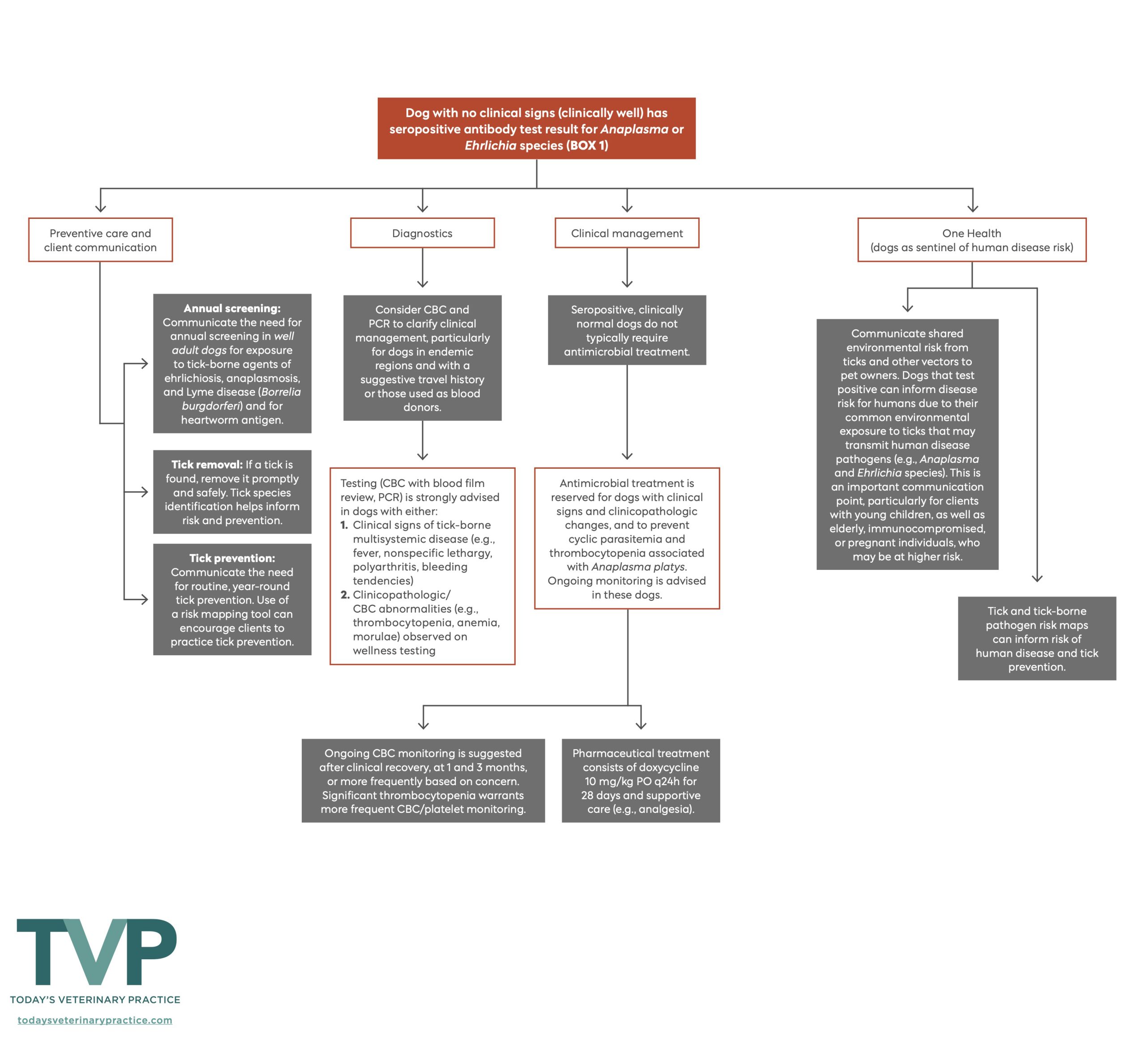
This algorithm serves as an aid to practitioners faced with seropositive test results for Anaplasma and Ehrlichia exposure in overtly healthy dogs to assist with next clinical steps and nuanced owner communication that incorporates One Health, blood donor management,8 and a spectrum of care.
References
- CAPC guidelines: ectoparasites. Companion Animal Parasite Council. Accessed May 13, 2026. https://capcvet.org/guidelines
- Canadian Parasitology Expert Panel. Guidelines for the management of parasites in dogs and cats. University of Saskatchewan. Updated July 24, 2019. Accessed May 13, 2026. https://research-groups.usask.ca/cpep
- Littman MP, Gerber B, Goldstein RE, Labato MA, Lappin MR, Moore GE. ACVIM consensus update on Lyme borreliosis in dogs and cats. J Vet Intern Med. 2018;32(3):887-903. doi:10.1111/jvim.15085
- Neer TM, Breitschwerdt EB, Greene RT, Lappin MR. Consensus statement on ehrlichial disease of small animals from the infectious disease study group of the ACVIM. American College of Veterinary Internal Medicine. J Vet Intern Med. 2002;16(3):309-315. doi:10.1892/0891-6640(2002)016<0309:csoedo>2.3.co;2
- Dixon DM, Branda JA, Clark SH, et al. Ehrlichiosis and anaplasmosis subcommittee report to the Tick-borne Disease Working Group. Ticks Tick Borne Dis. 2021;12(6):101823. doi:10.1016/j.ttbdis.2021.101823
- Parasite prevalence maps: tick borne disease agents, anaplasmosis, dog. Companion Animal Parasite Council. Accessed May 13, 2026. https://capcvet.org/maps/#/2026/all-year/anaplasmosis/dog/united-states
- Where ticks live. Centers for Disease Control and Prevention. July 30, 2025. Accessed May 13, 2026. https://www.cdc.gov/ticks/about/where-ticks-live.html
- Wardrop KJ, Birkenheuer A, Blais MC, et al. Update on canine and feline blood donor screening for blood-borne pathogens. J Vet Intern Med. 2016;30(1):15-35. doi:10.1111/jvim.13823