
To take the CE quiz, click here.
This quiz is open until October 2028.
Intercat tension is agonistic behaviors between cats, ranging from staring to a physical fight. Intercat tension is estimated to affect most multicat households and can impair cat and human welfare. Detecting subtle signs of intercat tension and intervening with changes to the environment that prevent future intercat tension is vital to preventing future escalation. To prevent intercat tension or when the relationship between cats is significantly damaged, creating positive associations through gradual introduction or reintroduction may be possible. In some cases, psychotherapeutics may be appropriate to reduce strong negative emotions that hinder treatment success.
Take-Home Points
- Many cats in multicat households experience intercat tension, which often goes unnoticed at first because signs of tension can be quite subtle (e.g., staring, blocking, hiding).
- Gradual introduction of a new cat may help prevent persistent tension.
- Because medical issues can contribute to intercat tension, potential underlying medical conditions should be ruled out.
- A treatment plan for intercat tension can follow the 3 M’s framework (management, modification, and medication).
- Using punishment (e.g., shouting, striking) is contraindicated because it can increase fear—worsening tension and damage the human–animal bond.
- A realistic outcome for intercat tension is that the cats may tolerate each other but not necessarily become friendly to each other.
Intercat tension broadly encompasses all agonistic behaviors between cats, from subtle conflict to intense aggression. Intercat tension is usually between 2 cats but can sometimes involve additional cats. It can happen during introduction of a new cat or anytime throughout cats’ relationship together.
Surveys indicate that intercat tension affects 62.2% to 87.7% of multicat households.1,2 Intercat conflict, usually exhibited by more overt signs of aggression, accounts for 25% to 31% of feline behavior cases presented to specialists.3-5 Intercat tension most commonly begins when a new cat is introduced into a household, comprising 73.3% of multicat households, followed by 23.6% due to gradual changes in a stable relationship and 3.1% from an abrupt behavior change such as a medical cause or external trigger.2
A common misconception is that “cats need to work it out themselves.” If tension persists, the cats’ relationship and welfare can deteriorate. The social structure among cats is flexible. Some cats live socially while others live independently.6 In environments in which independent living is hindered, tension persists. As tension builds, the effects can extend beyond the cats themselves, weakening the human–animal bond and increasing the likelihood of cat relinquishment.7
Identification
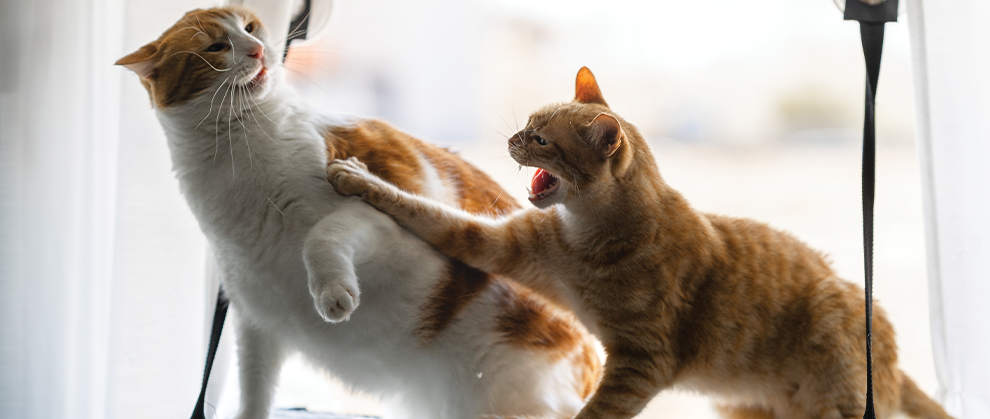
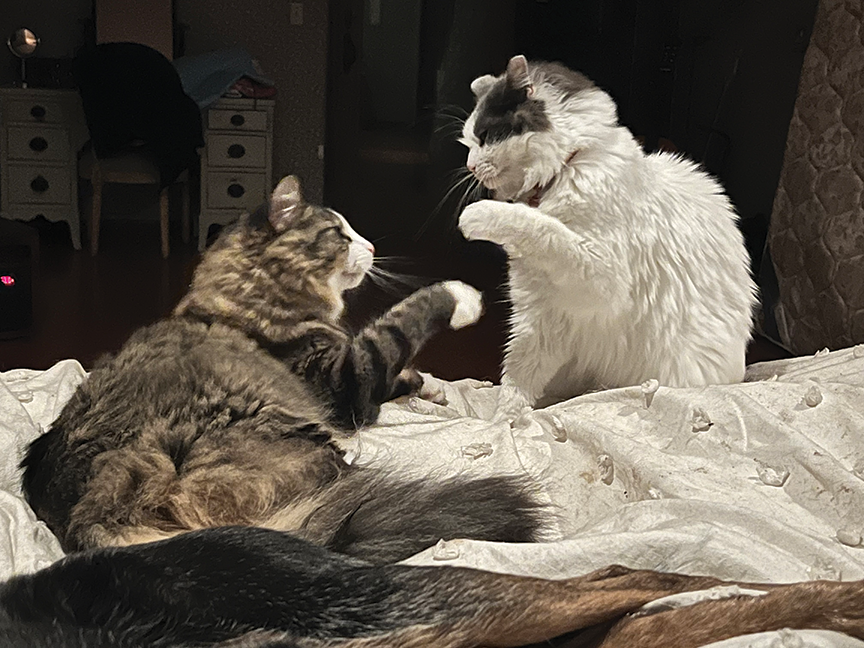
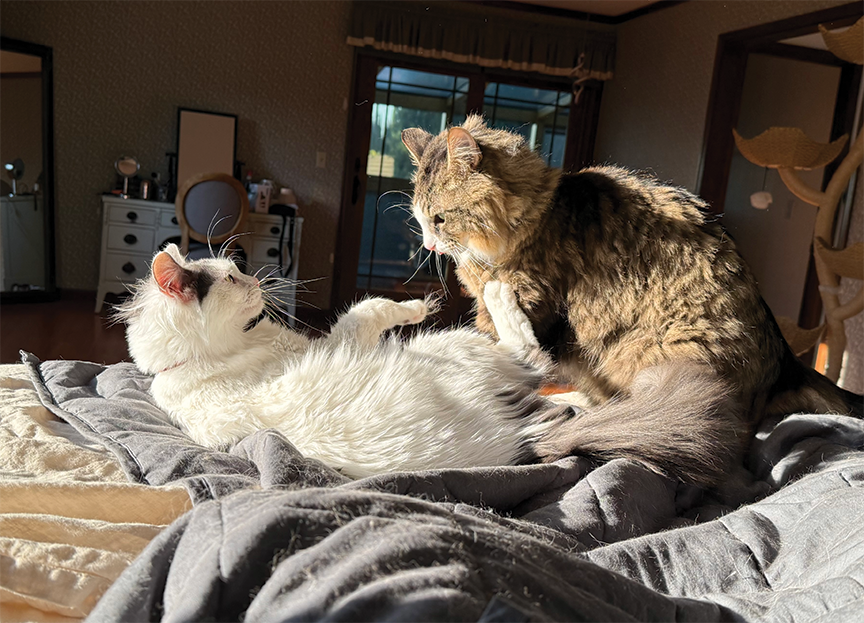
Clients often do not recognize intercat tension until after the cats have had a physical fight. By the time more obvious agonistic behaviors (e.g., hissing, screaming, swatting [FIGURE 1], biting) are observed, the relationship is already deteriorating. Commonly, the more subtle signs of tension (e.g., staring, blocking movement of the other, stiffness, tail thrashing, stalking) go undetected. The most common sign of intercat tension is staring (i.e., directing a prolonged, fixed gaze at the other cat [FIGURE 2]) and is found in 44.9% of multicat households.2
In a tense relationship, cats that appear to tolerate each other are actively avoiding direct interactions. More obvious agonistic behaviors between the cats can be absent for months despite daily tension. Cats may be prevented from access to key resources (e.g., litter box, food bowls) due to another cat using agonistic behaviors to block or chase them away. Even without physical altercations, the psychologic effects of chronic tension can be profound and easily misinterpreted. Cats that have experienced agonistic behaviors from another cat may act differently or even appear sick. They may hide more, eat less, or even engage in house soiling, which can result from primary intercat tension.
Diagnosis
When considering stress-related differential diagnoses for a feline patient living in a multicat household, ask about possible intercat tension. Veterinarians are uniquely positioned to detect tension early, investigate underlying causes, and intervene. During well-care appointments, ask clients if they have noticed subtle signs of conflict (e.g., staring, ears back, blocking off areas, tail lashing), particularly during key contexts such as mealtime, while receiving attention from the owner, or while moving around the house.
If intercat tension is identified, it can be helpful to gather information about the timeline, including the progression over time and any changes, such as the introduction of a new cat or a health change. Videos and photos of the cats interacting can provide additional details about their relationship; however, advise clients that they must not put their cats in physical danger or in a stressful situation for the purpose of obtaining a video.
There is a strong interplay between behavior and physical health. Physical health changes can influence or be exhibited as behavior, including intercat tension. Cats exhibiting changed behavior, including increased aggression or withdrawal, should receive a thorough veterinary assessment so that physical medical causes can be addressed.
A diagnostic workup for intercat tension includes a physical examination, with particular attention paid to areas of potential discomfort by completing thorough orthopedic, dermatologic, and neurologic examinations. Diagnostic testing (e.g., CBC, serum chemistry panel, urinalysis) is recommended to rule out systemic illness that alters behavior. Further diagnostic testing (e.g., blood pressure, thyroxine levels, imaging) may also be indicated.
Treatment
In addition to educating clients and treating underlying physical health concerns, a comprehensive treatment plan for intercat tension includes managing the cats’ environment and, in some cases, incorporating behavior modification and psychotherapeutics (BOX 1).
- Perform physical examination to rule out medical conditions.
- Separate cats, as necessary, to prevent further risk for physical and emotional injury.
- Identify and remove stressors based on behavioral history.
- Meet all feline environmental needs.
- Do not punish.
- Determine level of therapeutic support needed.
- Follow up soon and frequently.
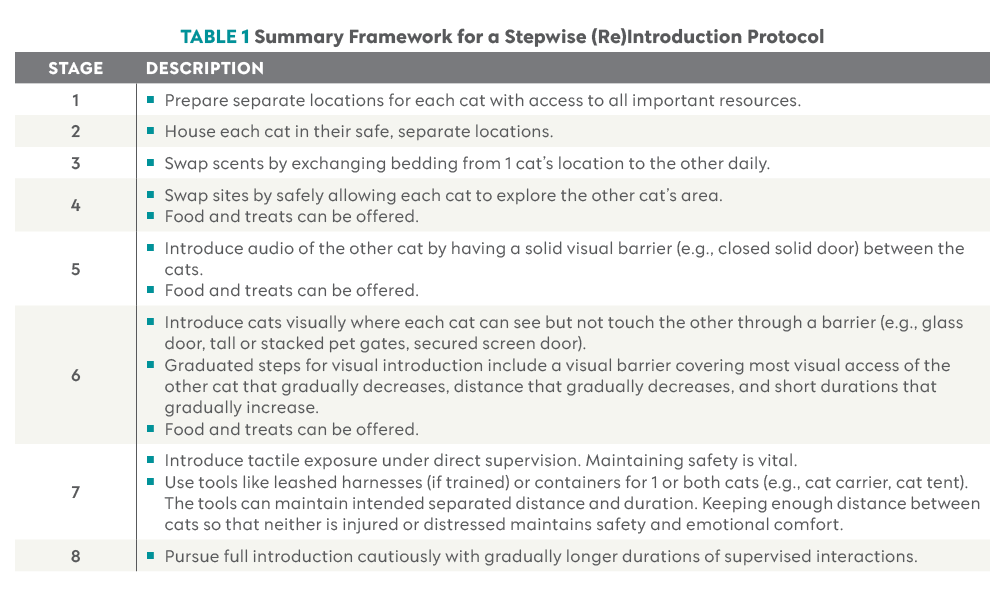
The 3 M’s multimodal framework (management, modification, and medication) offers an effective approach. A reintroduction plan can also be recommended if deemed appropriate (TABLE 1).
Management
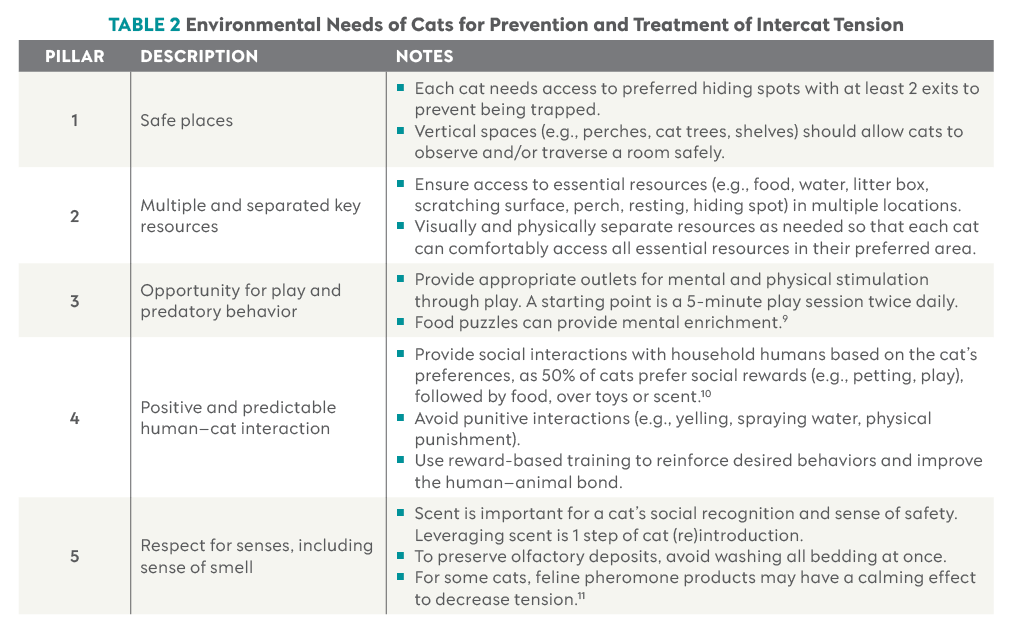
Managing intercat tension involves providing the cats’ behavioral and environmental needs and avoiding tension triggers to ensure safety. A helpful guide for meeting cats’ emotional needs is described in the framework of the 5 pillars of a healthy feline multicat environment (TABLE 2).12
In some cases, there are identifiable, specific, and controllable triggers that contribute to tension (e.g., mealtimes). Predictable triggers can be managed and avoided to prevent future tension (e.g., cat separation during mealtimes). For cases in which the triggers are chronic, more widespread, or unidentified, cats may need separation 100% of the time. In the beginning, solid secure barriers (e.g., doors) may be needed to ensure safety and prevent additional repeated events of tension. Sometimes, multiple barriers (e.g., multiple doors or gates separating the cats) are needed so that if a cat breaches a barrier, an additional barrier is in place to prevent unintentional interactions. Barriers may need to be visual (e.g., solid door, opaque window film) to prevent cats from staring or lunging or to block access to stressful environmental triggers (e.g., outdoor cats seen from the window).
Modification
Generally, behavior modification techniques are aimed at teaching cats coping skills when around each other. The focus of the modification is to reinforce wanted emotions and behaviors.
Clients may be inclined to react in an attempt to stop intercat tension (e.g., shout, make threatening noises, hurl things, use a squirt bottle, punish). However, those reactions are risky. When punitive measures are introduced to already tense cats, the cats may become more fearful and may associate the frightening experience with their proximity to the other cat. Cats can also associate their owner with the source of fear, damaging the human–animal bond and risking owner-directed aggression. Punishment is therefore contraindicated when dealing with intercat tension.13 When those risks are weighed during a physical cat fight, some interventions may require choosing the lesser harm rather than letting the cats fight it out or risking physical injury to a person (BOX 2).
- Make a loud sound (e.g., drop a book, clap) or, if necessary, toss water on the cats.
- Throw a blanket, towel, or upside-down laundry hamper between the cats.
- Separate the cats with a physical barrier (e.g., door).
Do not:
- Yell at or strike the cats.
- Reach in or put your body in between the cats.
- Ignore the situation and let the cats fight it out.
Caveat: In the event of a cat fight, the items in the “do” column are less risky options than those in the “do not” column but can still risk escalating fear, frustration, and potential redirected aggression toward the person, depending on the cats.
Classical Counterconditioning and Desensitization
One of the most common behavior modification recommendations is classical counterconditioning combined with desensitization. The goal of classical counterconditioning is to combine an inherently emotionally positive stimulus (e.g., high-value treats) with a negative stimulus (e.g., the other cat) to create a more positive association with the other cat. In successive pairings, the tense negative emotions associated with the other cat shift to positive emotions.13
However, classical counterconditioning alone may not be enough to reduce the fear associated with intercat tension. Success may be improved by adding systematic desensitization. Desensitization is careful introduction to the stimulus (e.g., the other cat) while making sure the cats are fully comfortable and that they remain comfortable throughout all therapy sessions.13 Success is increased by using slow successive steps, monitoring for signs of tension, and avoiding triggers. The steps might be introducing a stimulus associated with the other cat (e.g., scent, auditory, visual, tactile) at a time, while pairing each presentation and progression with high-value treats. The rate of progression varies widely from case to case.
It is paramount to go slowly and at the cats’ pace. Progression to the next step should be attempted only after both cats display relaxed body language and consistently and reliably take treats. If cats show evidence of tension during a training session, return to the previous successful step before proceeding more gradually. Continuing to progress forward while cats display tension can increase the risk for progressive tension to more obvious agonistic behaviors.
Operant Counterconditioning
Another behavior modification tool involves operant counterconditioning, in which cats are reinforced for engaging in specific desirable behaviors.13 Often, the reinforced behaviors are alternative to or incompatible with intercat tension at the same time, particularly more obvious agonistic behaviors. The most common behaviors to teach a cat include a recall, sending, stationing to a location (e.g., moving away to and/or sitting on a chair), and targeting (e.g., touching nose to a target). A cat cannot come to the owner or go to a station while also chasing the other cat. With sufficient learning history, a cat could find the trained behavior more reinforcing than intercat tension. Such behaviors can be incorporated into desensitization sessions.
Medication
When emotions of intercat tension are intense, the ability for the cat(s) to effectively learn through behavior modification may progress slowly or have limited success.13 Psychotherapeutics (e.g., drugs, nutritional supplements, nutraceuticals) can be used to reduce strong emotions that contribute to intercat tension such as anxiety, fear, or arousal. Although often beneficial, medication by itself is frequently insufficient for long-term improvement and should be used in conjunction with management and modification.14 Management and modification may be more effective for long-term progress, while psychotherapy lessens the emotional load.
Selection of psychotherapeutic agents should be based on the individual case. One size does not fit all. Several factors to consider are the patient’s health status, diagnosis, compliance with therapeutic agent administration, and its potential benefits and adverse effects.
Cats exhibiting chronic intercat tension may benefit from chronic, daily medication. These drug classes include selective serotonin reuptake inhibitors, tricyclic antidepressants, and serotonin norepinephrine reuptake inhibitors.15 Other drugs that have also been used chronically to minimize intercat tension include gabapentin, buspirone, and nutraceuticals.16 Buspirone may increase confidence in some cats (particularly cats that are more prone to withdraw or flee), which may be beneficial, but may potentially increase the risk for intercat tension and increase agonistic behaviors in some cats. Further details can be found in several pharmacology texts.14,17,18
For intercat tension, all behavior medications are used extralabel. Clients should be informed about what to expect from medicating their cat and should provide informed consent. They should be advised of the period needed before a medication’s effectiveness might be noted as well as any potential adverse effects. Duration of treatment and suggested timing of follow-up reevaluations should be outlined. Guidance on safe and stress-free medication administration should also be provided.19
Prognosis
A good outcome is possible when intercat tension is mild, with early detection and treatment. In most cases, when intercat tension has led to more obvious signs of agonistic behaviors, complete resolution of the intercat tension is unlikely. A more reasonable outcome is decreased frequency and intensity of the tension, with realistic hope to reach tolerance or coexistence between the cats. For the few challenging cases, the best welfare outcome may require permanent separation or rehoming.
Prevention
Preventing intercat tension requires recognizing common triggers, meeting feline environmental needs, and gradually introducing the cats. Common triggers include the presence of outdoor cats, separation with reunion (e.g., after veterinary visits), physical health conditions or impairments (e.g., illness, painful conditions), and household changes (e.g., removal or arrival of a pet or person, refurbishment, moving).
Although a recent survey did not show that intercat tension can be prevented with increased space and resources,2 providing the 5 pillars of a healthy feline environment is an enduring recommendation.12 Appropriate proactive management and modification for gradual introduction may also serve to help prevent development of intercat tension. Introducing a new cat should follow a gradual, individualized introduction process that respects feline social behavior and each cat’s temperament. Caregivers should remain observant for early signs of tension so that interventions can be implemented promptly before tension escalates.
Summary
Intercat tension is among the most common behavioral concerns in multicat households and becomes obvious when fights occur. However, subtle signs could be early warning signs of intercat tension. Chronic tension can lead to welfare concerns, medical illness, and risk for relinquishment. A treatment plan often includes separation, providing for feline behavioral needs, using a carefully structured reintroduction protocol, and incorporating psychotherapeutics (when indicated). Early intervention may lead to a good prognosis, but tolerance is a more realistic expectation.
References
- Roberts C, Gruffydd-Jones T, Williams JL, Murray JK. Influence of living in a multicat household on health and behaviour in a cohort of cats from the United Kingdom. Vet Rec. 2020;187(1):27. doi:10.1136/vr.104801
- Elzerman AL, dePorter TL, Beck A, Collin JF. Conflict and affiliative behavior frequency between cats in multicat households: a survey-based study. J Feline Med Surg. 2020;22(8):705-717. doi:10.1177/1098612X19877988
- Ramos D, Reche-Junior A, Hirai Y, Mills DS. Feline behaviour problems in Brazil: a review of 155 referral cases. Vet Rec. 2020;186(16):e9. doi:10.1136/vr.105462
- Bamberger M, Houpt KA. Signalment factors, comorbidity, and trends in behavior diagnoses in cats: 736 cases (1991–2001). JAVMA. 2006;229(10):1602-1606. doi:10.2460/javma.229.10.1602
- Amat M, de la Torre JLR, Fatjó J, Mariotti VM, Van Wijk S, Manteca X. Potential risk factors associated with feline behaviour problems. Appl Anim Behav Sci. 2009;121(2):134-139. https://doi.org/10.1016/j.applanim.2009.09.012
- Crowell-Davis SL, Curtis TM, Knowles RJ. Social organization in the cat: a modern understanding. J Feline Med Surg. 2004;6(1):19-28. doi:10.1016/j.jfms.2003.09.013
- Salman MD, Hutchison J, Ruch-Gallie R, et al. Behavioral reasons for relinquishment of dogs and cats to 12 shelters. J Appl Anim Welf Sci. 2000;3(2):93-106. https://doi.org/10.1207/S15327604JAWS0302_2
- Rodan I, Ramos D, Carney H, et al. 2024 AAFP intercat tension guidelines: recognition, prevention and management. J Feline Med Surg. 2024;26(7):1098612X241263465. doi:10.1177/1098612X241263465
- Dantas L, Delgado M, Johnson I, Buffington T. Food puzzles for cats: feeding for physical and emotional wellbeing. J Feline Med Surg. 2016;18(9):723-732. doi:10.1177/1098612X16643753
- Vitale Shreve KR, Mehrkam L, Udell MAR. Social interaction, food, scent or toys? A formal assessment of domestic pet and shelter cat (Felis silvestris catus) preferences. Behav Processes. 2017;141(Pt 3):322-328. doi:10.1016/j.beproc.2017.03.016
- DePorter TL, Bledsoe DL, Beck A, Ollivier E. Evaluation of the efficacy of an appeasing pheromone diffuser product vs placebo for management of feline aggression in multicat households: a pilot study. J Feline Med Surg. 2019;214(4):293-305. doi:10.1177/1098612X18774437
- Ellis SLH, Rodan I, Carney HC, et al. AAFP and ISFM feline environmental needs guidelines. J Feline Med Surg. 2013;15(3):219-230. doi:10.1177/1098612X13477537
- Landsberg G, Radosta L, Ackerman L. Pharmacologic intervention in behavioral therapy. In: Landsberg G, Radosta L, Ackerman L, eds. Behavior Problems of the Dog and Cat. 4th ed. Elsevier; 2024:183-214.
- Crowell-Davis SL, Murray TF, de Souza Dantas LM, eds. Veterinary Psychopharmacology. 2nd ed. Wiley-Blackwell; 2019.
- Masson S, Metz D, Bleuer-Elsner S, Schwobthaler F. Retrospective study on the use of venlafaxine in 176 cats diagnosed with behavioral disorders. J Vet Behav. 2025;77:1-10. https://doi.org/10.1016/j.jveb.2024.11.004
- Tynes VV, Landsberg GM. Nutritional management of behavior and brain disorders in dogs and cats. Vet Clin North Am Small Anim Pract. 2021;51(3):711-727. doi:10.1016/j.cvsm.2021.01.011
- Denenberg S, Dubé MB. Tools for managing feline problem behaviours: psychoactive medications. J Feline Med Surg. 2018;20(11):1034-1045. doi:10.1177/1098612X18806760
- Budde JA, McCluskey DM. Plumb’s Veterinary Drug Handbook. 10th ed. Wiley-Blackwell; 2023.
- Animal Behavior Service LLAC. Training your pet to take medication. YouTube. February 12, 2014. Accessed July 26, 2026. https://www.youtube.com/watch?v=spjJNcycRMQ
CE Quiz
This article has been submitted for RACE approval for 0.5 hours of continuing education credit and will be opened for enrollment upon approval. To receive credit, take the test at vetfolio.com. Free registration is required. Questions and answers online may differ from those below. Tests are valid for 2 years from the date of approval.
1. Which is the most common subtle sign of intercat tension?
a. Staring
b. Wailing
c. Hissing
d. Swatting
2. Which of the following is the best first step when a client reports that their 2 cats have been physically fighting?
a. Separate cats into different rooms.
b. Immediately start lorazepam in both cats.
c. Let them “work it out” to establish hierarchy.
d. Spray both cats with water to interrupt the fight.
3. Which resource arrangement is most appropriate in a multicat household?
a. One litter box in a central location
b. A single elevated perch for all cats
c. Shared feeding stations for social bonding
d. Physically separated resource areas for each cat
4. Which behavior modifications for intercat tension are most commonly recommended?
a. Punishment and desensitization
b. Punishment and counterconditioning
c. Desensitization and operant counterconditioning
d. Desensitization and classical counterconditioning
5. Which is the most realistic favorable outcome for treating intercat tension?
a. The aggressor cat is rehomed.
b. The cats become bonded companions.
c. The aggressive episodes are minimized.
d. The cats are permanently housed separately.