

Daily veterinary practice increasingly relies on rapid, informed clinical decision-making. In this setting, in-clinic hematology, particularly the complete blood count (CBC), has become a key diagnostic tool, offering immediate insight into a patient’s hematological status during the consult itself. The ability to generate high-quality CBC results within minutes allows clinicians to move from initial assessment to informed action — often in real time — helping to reduce diagnostic uncertainty.
This immediacy is especially critical in common clinical scenarios where hematologic evaluation directly informs case management. Anemia investigations frequently rely on timely assessment of red blood cell (RBC) indices to guide differentiation between blood loss, hemolysis, or decreased production. Similarly, chronic disease workups often depend on subtle hematologic changes to support broader diagnostic reasoning, while gastrointestinal (GI) disease, inflammatory conditions, and systemic illnesses can all present with hematologic signatures that shape both diagnostic pathways and treatment plans.
However, clinicians must often balance the need for fast results with the level of diagnostic depth needed to properly characterize a case. Reference laboratories provide comprehensive analysis, advanced methodologies, and expert interpretation, but turnaround times can limit their utility for immediate, first-line decision-making. In contrast, in-clinic analyzers offer speed and convenience, yet have historically been perceived as providing less granular insight than reference laboratory testing.
This tension has driven a broader evolution in veterinary diagnostics. Today, the emphasis is not just on speed of results, but on ensuring those results are sufficiently detailed, reliable, and clinically meaningful enough to support confident decision-making at the point of care.
The Diagnostic Gap
Within the standard CBC, mean corpuscular hemoglobin concentration (MCHC) is a widely used parameter that contributes to the evaluation of suspected anemia. While clinically valuable, it is important to recognize that MCHC is a calculated value, derived from hemoglobin concentration and hematocrit, and therefore represents an average across the entire RBC population rather than a direct measurement of individual cells.
This distinction introduces inherent limitations. Because MCHC reflects population-level estimates, it may mask subtle degrees of hypochromia1, particularly in early-stage disease or in cases where only a subset of RBCs is affected. Similarly, mixed RBC populations, such as those seen in regenerative responses or concurrent disease processes, can be obscured within a single averaged value, potentially reducing diagnostic sensitivity1.
MCHC is also known to be sensitive to pre-analytical artifacts. Interferents such as lipemia, icterus, hemolysis, large numbers of Heinz bodies, and red blood cell agglutination can artificially elevate MCHC values, creating the appearance of increased intracellular hemoglobin concentration even when this is not physiologically accurate2. A high MCHC is always an artifact since RBCs cannot contain more hemoglobin than normal. This can make interpretation more challenging, with clinicians having to reconcile potentially misleading data with the clinical picture.
Such limitations position MCHC as a valuable but imperfect tool; one that provides useful information yet may not always be sufficient in isolation to fully characterize RBC morphology or hemoglobin status2. As clinical expectations for precision and clarity continue to rise, this diagnostic gap highlights the need for parameters that provide a more direct and nuanced assessment of RBC health within the in-clinic setting, enabling more confident decision-making and more informed treatment plans.
Closing the Gap with CHCM
Cellular Hemoglobin Concentration Mean (CHCM) is a directly measured red cell parameter that offers clinicians a more precise view of RBC hemoglobin status. Instead of relying on population-level calculations, individual red blood cells are analyzed to reveal what is actually happening at the level of each cell. This approach captures subtle variation within the RBC population, including early or mild hypochromia, mixed cell populations, or emerging regenerative patterns that may be obscured when relying solely on calculated indices3.
Crucially, CHCM is less susceptible to the many distortions that can artificially elevate MCHC3,4. It does not depend on hematocrit or total hemoglobin concentration, so it avoids many of the interferences caused by lipemia, icterus, hemolysis, large numbers of Heinz bodies, or agglutination, providing a more reliable reflection of true intracellular hemoglobin concentration3,4.
Until recently, CHCM was a parameter available only in reference laboratories. Its addition to Zoetis’ Vetscan OptiCell™ device marks the first time this measurement can be performed on a point-of-care hematology analyzer. CHCM represents a significant advance for in-house hematology, bringing laboratory-grade insight directly into the clinic and helping meet the growing expectations for diagnostic precision at the point of care.
Case Study: Cody the Border Collie
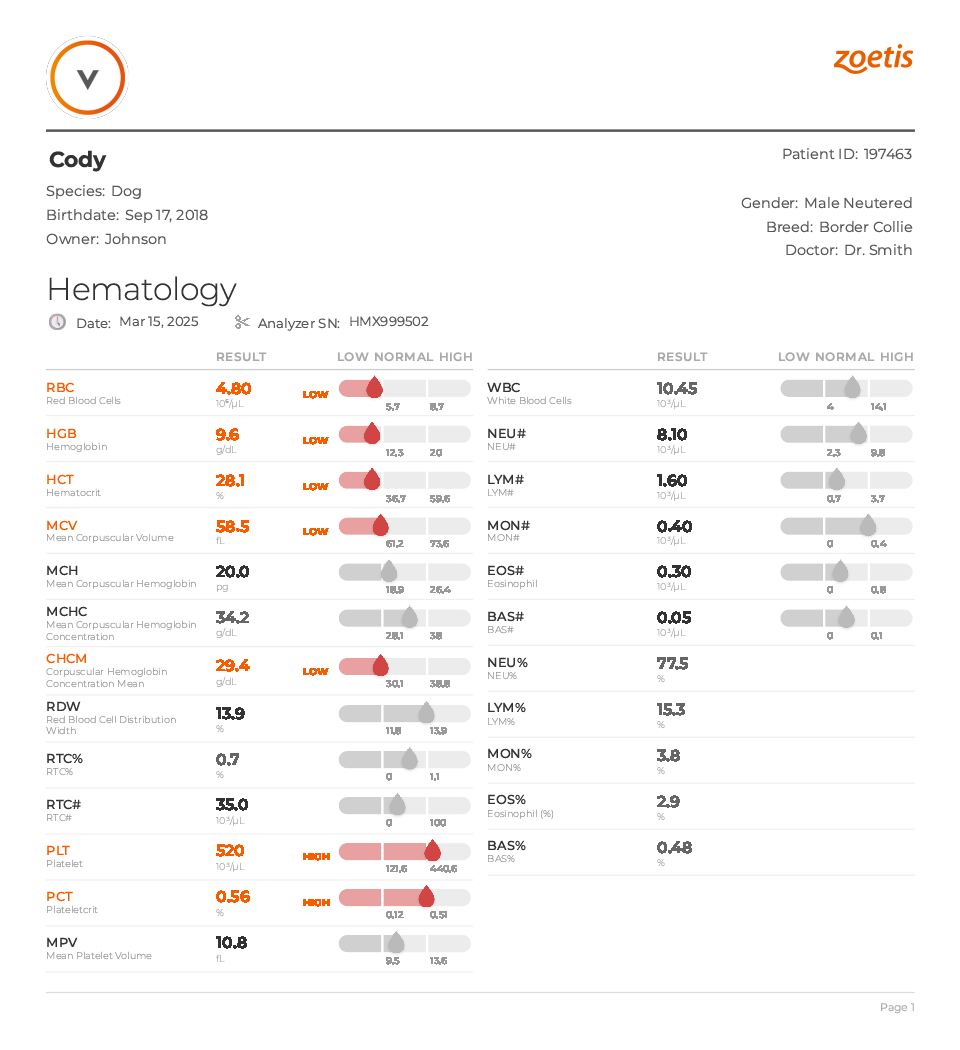
Cody, a 7-year-old neutered male Border Collie, presented with intermittent diarrhea and soft stools, often accompanied by mucus and occasional streaks of blood. His owner noted recent stiffness and had been administering over-the-counter aspirin. Despite a normal appetite, Cody had also experienced progressive weight loss over the past six weeks.
On examination, Cody showed mild cranial abdominal discomfort and lumbosacral sensitivity. Rectal examination revealed mucoid stool containing small amounts of fresh blood, supporting the history of intermittent hematochezia. Cody was up to date on parasite prophylaxis. To understand the cause, a CBC and chemistry panel were performed.
Diagnostic Findings
Hematology revealed a moderate non-regenerative anemia, with a hematocrit (HCT) of 28.1% consistent with the estimated packed cell volume (PCV). Red cells were microcytic, and while the MCHC remained borderline and did not clearly indicate hypochromia, the CHCM confirmed reduced intracellular hemoglobin concentration, resolving the ambiguity of relying on calculated indices alone. The MCHC might have been affected by factors that impact either the MCV and/or the hemoglobin measurement, such as a certain degree of hemolysis. Thrombocytosis, another common feature of iron deficiency, was also present.
The chemistry profile showed mild hypoproteinemia driven by hypoalbuminemia, with normal globulins. Blood urea nitrogen (BUN) was mildly increased with normal creatinine, and total calcium was slightly reduced, most consistent with hypoalbuminemia. These findings may reflect chronic gastrointestinal blood loss or concurrent inflammatory processes.
Taken together, the combination of microcytosis, low CHCM, thrombocytosis, and chronic gastrointestinal signs signaled iron deficiency secondary to chronic gastrointestinal blood loss, potentially exacerbated by recent aspirin administration.
.
The Outcome
The clarity offered by CHCM helped strengthen the interpretation of the hematology findings and guided a more targeted clinical plan; this included performing a serum iron profile to confirm iron deficiency, pursuing gastrointestinal investigation to identify the source of the chronic blood loss, and discontinuing aspirin to minimize further mucosal injury.
By confirming true hypochromia where MCHC alone could not, CHCM directly influenced clinical decisions in Cody’s case, supporting a confident and targeted diagnostic pathway. This illustrates the value of CHCM in translating hematological data into clear, actionable insights at the point of care, benefiting clinic workflows, patient care, and client experience.
CHCM in Practice
Cody’s case demonstrates how CHCM can strengthen the interpretation of red cell parameters, reduce uncertainty, and support clear, fast decision-making at the point of care. Having these insights available in clinic can avoid delays while waiting for reference laboratory confirmation, allowing for streamlined workflows and elevating the overall quality of patient care. By revealing subtle hypochromia or early shifts in RBC population characteristics, CHCM supports early recognition of conditions such as iron deficiency or chronic inflammatory disease to enable timely intervention. The direct measurement also helps reconcile clinical presentation with hematological findings, helping to reduce ambiguity and support a more coherent interpretation of cases.
More broadly, the introduction of CHCM into point-of-care hematology reflects a wider evolution in how clinicians generate and interpret diagnostic data. By working alongside traditional CBC parameters, CHCM adds a cell-level perspective that enhances the value of established indices. It also complements emerging AI-driven cell analysis, supporting a more nuanced understanding of red cell morphology and population dynamics. Together, these tools contribute to a more precise view of hematological status and help bridge the gap between point-of-care testing and reference laboratory analysis — addressing the balance between speed and depth of insight highlighted earlier.
The Future of Hematology
For decades, clinicians have relied on calculated averages to understand red cell health, yet the introduction of in-clinic CHCM marks a shift toward a deeper picture. As practices adopt more advanced point-of-care technologies and AI-driven cell analysis becomes increasingly integrated, the need for detailed, reliable, and immediately actionable insights continues to grow. Within this context, CHCM strengthens — rather than replaces — indices like MCHC. It fits seamlessly into modern workflows, increasing the depth and reliability of in-house hematology, and enabling a future where AI-hematologic technology becomes a routine part of everyday clinical practice.
References
- Walker, H.K., Hall, W.D. and Hurst, J.W. (eds.) (1990) *Clinical Methods: The History, Physical, and Laboratory Examinations*. 3rd edn. National Center for Biotechnology Information. Available at: https://www.ncbi.nlm.nih.gov/books/NBK260/
- Girard, S., Berda-Haddad, Y., Brouzes, C., Badaoui, B., Boussaroque, A., Janel, A., Chatelain, B. and Baccini, V. (2025) ‘Breaking free from MCHC interferences? Review of causes, rising trends and practical solutions’, International Journal of Laboratory Hematology, 47(5), pp. 798–807. Available at: https://pmc.ncbi.nlm.nih.gov/articles/PMC12426809/
- eClinPath, Cornell University College of Veterinary Medicine (n.d.) ‘MCHC/CHCM’. Available at: https://eclinpath.com/hematology/tests/mchc/
- Chen, Y., Li, S., Mu, Y. et al. (2026) ‘Mechanistic investigation and data-driven correction of lipemic interference in hematological parameters’, Practical Laboratory Medicine, 49, e00521.