
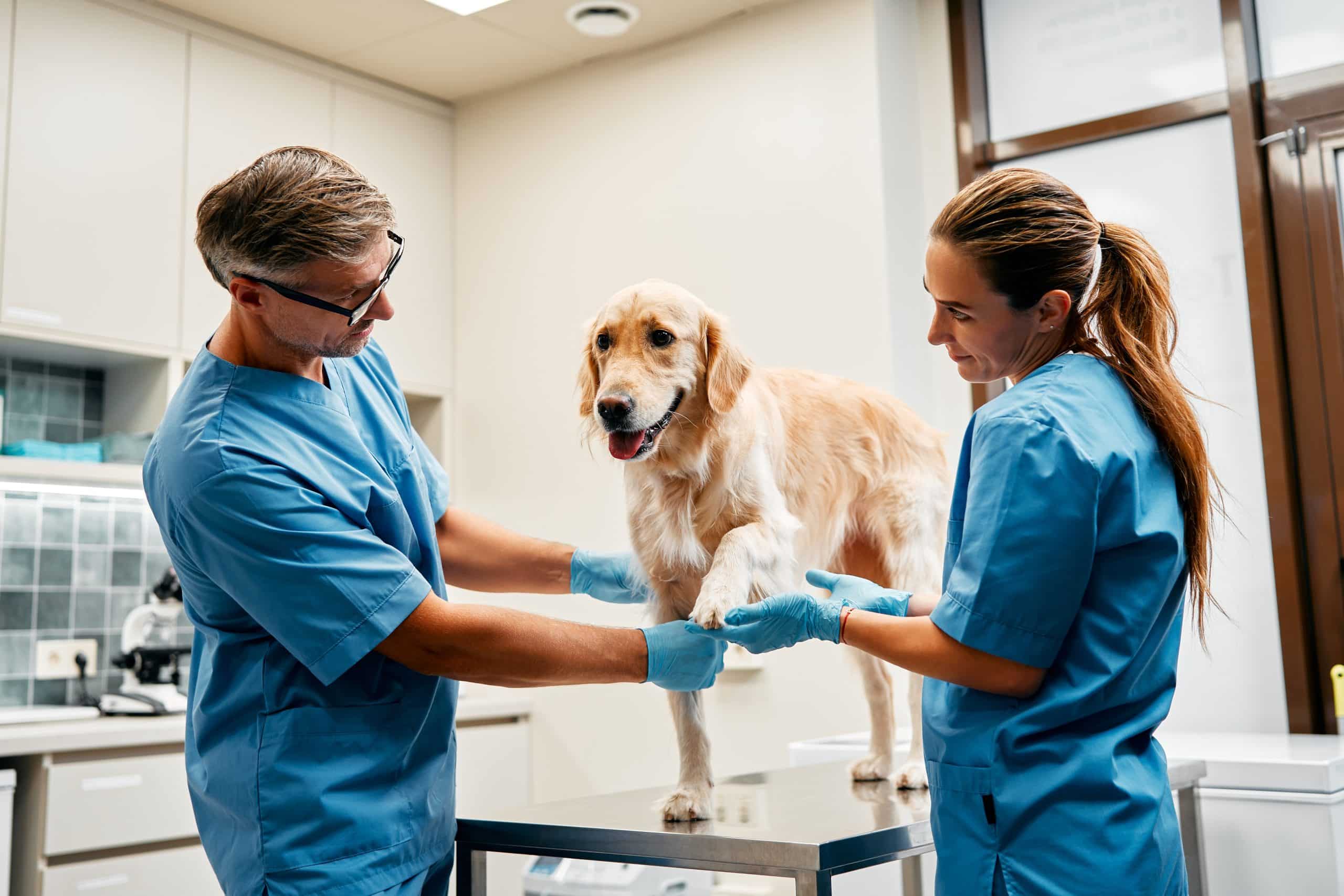
Multimodal pain management (MMPM) should be instituted in every veterinary practice. Although the exact protocols will depend on individual practice resources, the basic components of MMPM are1-3:
- Pharmaceuticals
- Nonpharmaceutical therapies
- Staff and client education
- Documentation
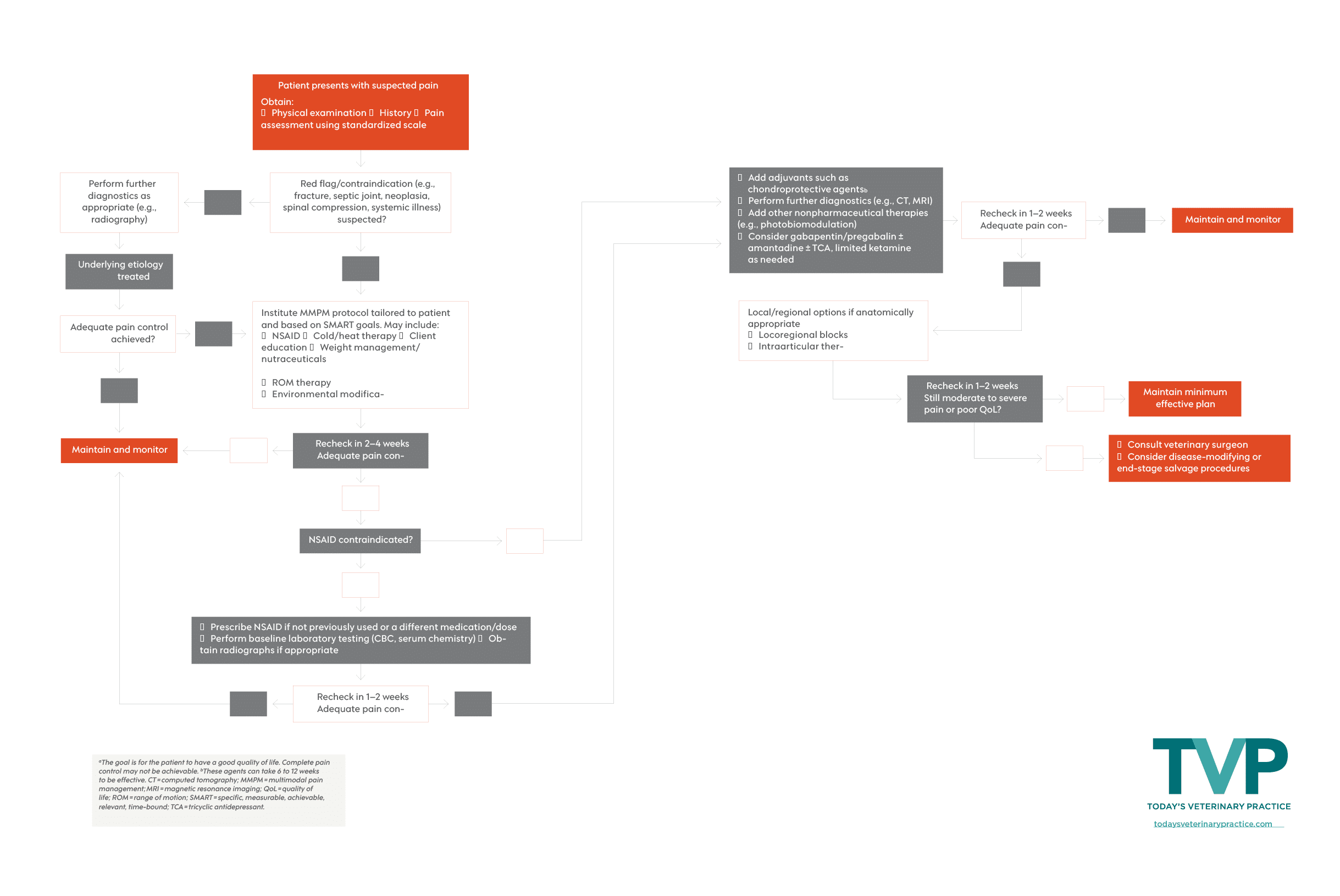
Initial Patient Assessment
For any patient with suspected pain, a thorough physical examination and history are essential parts of the workup. If a fracture, spinal compression, or other orthopedic issue is suspected, radiographs should be obtained as part of the initial screening process. If there is no improvement in the expected time frame for the suspected injury, additional imaging may be warranted.
Acute Versus Chronic Pain
It is important to distinguish between acute and chronic pain when developing a pain management protocol. Acute pain typically lasts from 2 to 12 weeks and resolves with appropriate treatment. Chronic pain can begin as soon as 2 weeks postinjury.
If pain persists longer than 12 weeks, it should be considered chronic, and long-term analgesia should be considered. This may include continued use of NSAIDs and adjuvant medications, regular monitoring, and periodic reassessment. Nonpharmaceutical therapies such as photobiomodulation (cold laser therapy) and ongoing range-of-motion (ROM) exercises can help maintain joint mobility and comfort in chronic cases.3
Components of Multimodal Pain Management
The following categories outline a starting point for practices instituting MMPM. Individual patient treatment plans should be based on SMART (specific, measurable, achievable, relevant, time-bound) goals for improvement. Ongoing management may require laboratory testing, tapering/rotation of medications, and regular reassessment every 4 to 12 weeks.
Pharmaceuticals
At minimum, initial pharmaceutical MMPM options should include a representative from each of the following classes. With increased team experience and comfort with MMPM, other pharmaceuticals can be added.
- NSAIDs: Have at least 2 options in case a patient experiences adverse effects (e.g., gastrointestinal upset) on 1. Popular options include grapiprant, carprofen, robenacoxib, and meloxicam. NSAIDs can be administered orally, intravenously, or subcutaneously; clarify the route based on patient needs.
- Neuropathic pain medications, such as a gabapentanoid or NMDA (N-methyl-d-aspartate ) antagonist
- Opioids
- Combinations: NSAIDs and opioids can be used together for enhanced analgesia (e.g., carprofen and tramadol).
- Local blocks: Surgery and local blocks are effective for acute pain. For chronic pain, periodic local blocks may be considered if appropriate.
Nonpharmaceutical Therapies
This category covers what the clinic staff can perform and what clients can do at home. Over time, more advanced therapies such as photobiomodulation can be added based on practice interest.
- ROM exercises: These include both passive ROM movements and limited use of the affected limb. Provide clients with detailed instructions on frequency (e.g., 1 to 2 times daily), duration (5 to 10 minutes per session), and whether ROM therapy is short-term (up to 12 weeks for acute pain) or long-term (ongoing for chronic pain to maintain joint mobility).
- Application of cold and heat: Often overlooked, these therapies are beneficial.4 Cold therapy is best for immediate postinjury use, while heat therapy is used for chronic inflammation. Both cold and heat can be applied at the site of the injury for 10 to 30 minutes 3 to 6 times daily. The time between applications should be at least as long as the application time period. Always monitor the skin for signs of thermal injury.
- Weight management/nutritional therapy: Pets should be at an optimal weight and be on a complete, balanced diet. For chronic concerns such as hip arthritis, having the body condition score be slightly thin can be helpful.
- Environmental modification: The use of aids such as ramps for stairs and minimizing slippery walking surfaces should be considered.
Staff and Client Education
Education is paramount. For clients, many of the educational concepts can be printed and provided along with links to approved online videos demonstrating at-home techniques. For staff, training in how to use a standardized pain scale to assess the patient and document the score is one of the most important steps. All staff members must use consistent criteria to reduce interobserver error (i.e., a score of 1 must be consistent among all staff).
Documentation
Documentation of all therapeutic measures used allows trends to be noted to guide further treatment if necessary.
References
- Lamont LA. Multimodal pain management in veterinary medicine: the physiologic basis of pharmacologic therapies. Vet Clin North Am Small Anim Pract. 2008;38(6):1173-1186, v. doi:10.1016/j.cvsm.2008.06.005
- Ihrke A. Multimodal approach to pain management in veterinary rehabilitation. Vet Clin North Am Small Anim Pract. 2023;53(4):731-742. doi:10.1016/j.cvsm.2023.02.006
- Gruen ME, Lascelles BDX, Colleran E, et al. 2022 AAHA pain management guidelines for dogs and cats. JAAHA. 2022;58(2):55-76. doi:10.5326/JAAHA-MS-7292
- Dragone L, Heinrichs K, Levine D, Tucker T, Millis D. Superficial thermal modalities. In: Millis D, Levine D, eds. Canine Rehabilitation and Physical Therapy. 2nd ed. W.B. Saunders, 2014:312-327.